The Norwegian Forest Cat: a cat from the forests of legend
A coat that holds snowflakes like icing sugar, lynx tufts on her ears, and the art of climbing head first down a tree: the Norwegian Forest Cat comes from the forests and fairy tales of the North. A portrait of the quiet queen of the fjords.
 AI-generated
This article contains affiliate links in the section “Made for big cats”, marked (#ad). If you buy through them, CatMind Studio earns a small commission at no extra cost to you. As an Amazon Associate we earn from qualifying purchases.
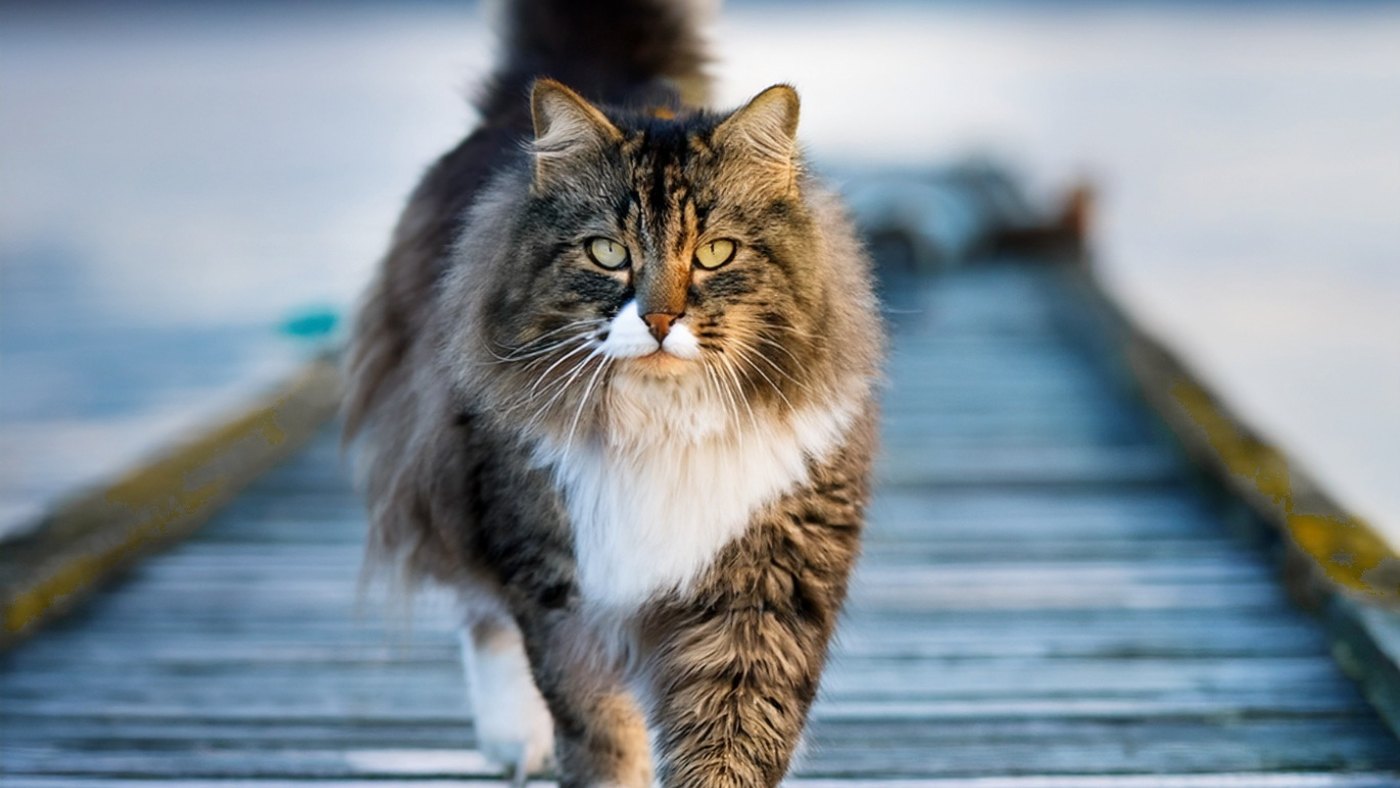
Picture a fjord on a morning in late October. Mist still lies on the water, the mountains wear their first snow, and along an old wooden jetty a large tabby cat is walking towards you. She is in no hurry. Her tail stands upright like a banner, the ruff around her neck lifts with every step, and when she stops she looks at you with that calm, knowing gaze, as if she had been waiting here long before anyone built the jetty.
In Norway she is called skogkatt, the forest cat. A plain name for a creature that has gathered more stories around her than almost any other cat of the North.
A cat out of the sagas
Long before there were stud books, she lived in fairy tales. Norwegian folklore tells of troll cats and fairy cats, the huldrekatt: big animals with bushy tails that could climb sheer rock faces no other cat could manage. And anyone who thinks of Freyja, the Norse goddess of love and beauty, may picture her chariot drawn by two cats. The old texts never say what those cats looked like. Still, many who imagine the scene today see two magnificent forest cats in harness. We tell the whole story in Freyja's Cats.
Where she truly comes from, no one knows for certain, and that is part of her spell. Perhaps her ancestors sailed with the Vikings as short-haired farm cats that kept mice away from the stores. Perhaps traders later brought long-haired cats from the East. What is certain is what the centuries made of them: cats that lived in the forests and on the farms of Scandinavia, through winters when the sun barely clears the horizon, becoming with each generation a little more of what we admire today.
A coat that sheds the rain
Watch a forest cat in the snow and you are watching a small marvel of adaptation. Her coat has two layers. On top lies a long, glossy guard coat that can repel water, so that snowflakes rest on it like icing sugar. Beneath it is a dense, woolly undercoat that holds the warmth. The coat is thickest on the chest, legs and head, exactly where a body in the wind needs it most. In spring she sheds much of that wool and wears a lighter gown through the summer. In autumn the full splendour returns: ruff, britches and a tail as long as her body.
Her head forms an equilateral triangle, and her profile runs straight from brow to nose. Her ears are large, often tipped with lynx-like tufts, and her big almond-shaped eyes give her the expression that people who love the breed struggle to put into words. Alert, serene and a little wild, all at once.
Head first down the trunk
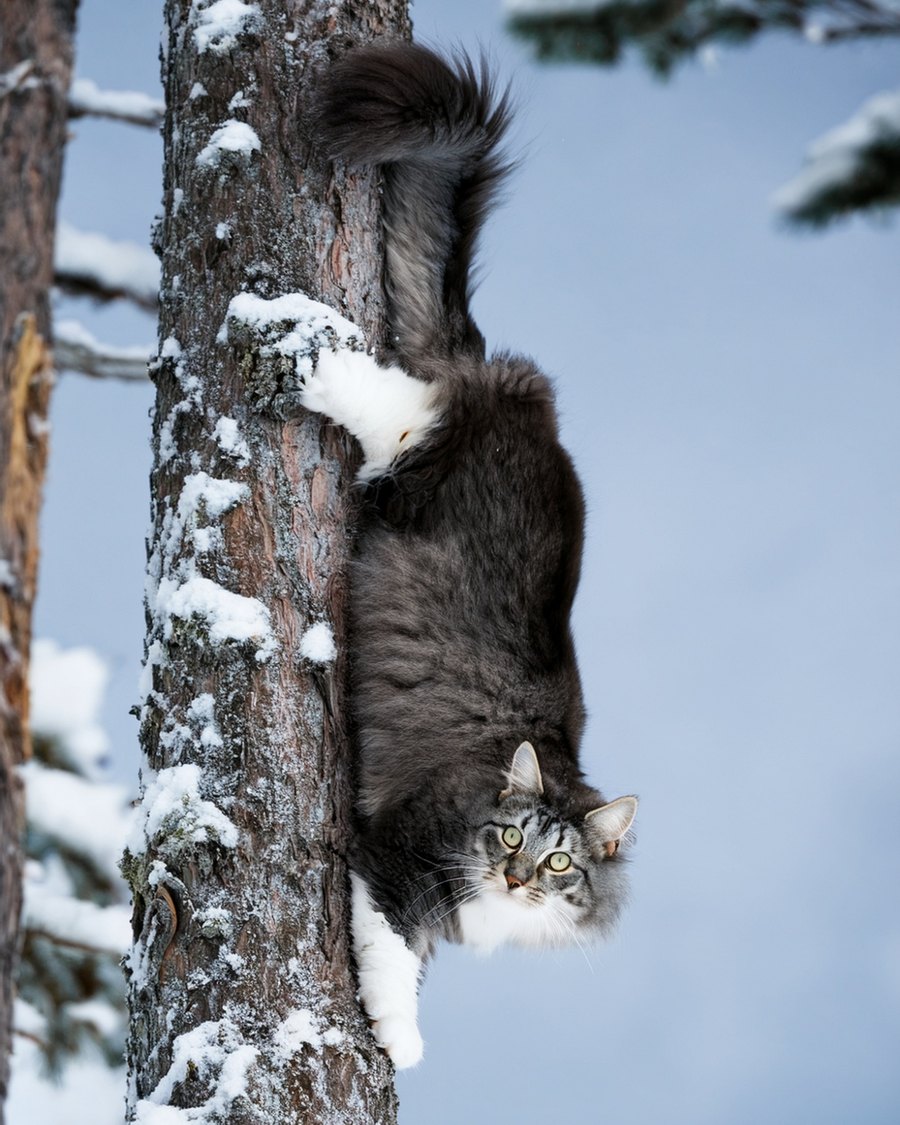
Most cats climb a tree and come back down backwards, carefully, one paw at a time. The forest cat is famous for being able to descend head first, her strong claws sunk deep in the bark, her body stretched along the trunk. Once you have seen it, you understand where the old tales of rock-climbing cats came from. Indoors, too, she seeks height. A tall, sturdy cat tree is not a piece of furniture to her. It is a lookout.
 AI-generated
A calm and friendly soul
For all her wild looks, she is gentle to live with. Forest cats are known as even-tempered, friendly and affectionate without being demanding. Many like to be near their people, following them from room to room and settling close by without necessarily wanting a lap. They play long and gladly, well into adulthood, and they watch with great patience. A window onto the birds can be a whole afternoon.
She takes her time growing up. Many reach their full size and build only at three to five years old. Males often weigh between 4.5 and 9 kilograms (10 to 20 pounds), females between 3.5 and 8 (8 to 18 pounds). To live with a forest cat is to watch a slow unfolding, winter after winter.
Saved by people who loved her
That the Norwegian Forest Cat still exists today is thanks to a handful of people in Norway. In the 1930s they began to preserve the forest cats deliberately. The war interrupted their work, and afterwards the breed's distinctive traits risked disappearing into the wider population of house cats. In the 1970s a breeding programme took up the work again. A male named Pans Truls, born in 1973, became the model for the first breed standard. In 1977 the Fédération Internationale Féline (FIFe) granted the breed full recognition. That same year the first forest cats travelled to Sweden, and in 1979 to the United States. It is often said that King Olav V declared her Norway's national cat. Whether that is true cannot be confirmed, and yet the story suits her so well that it keeps being told.
Amber, a secret in the coat
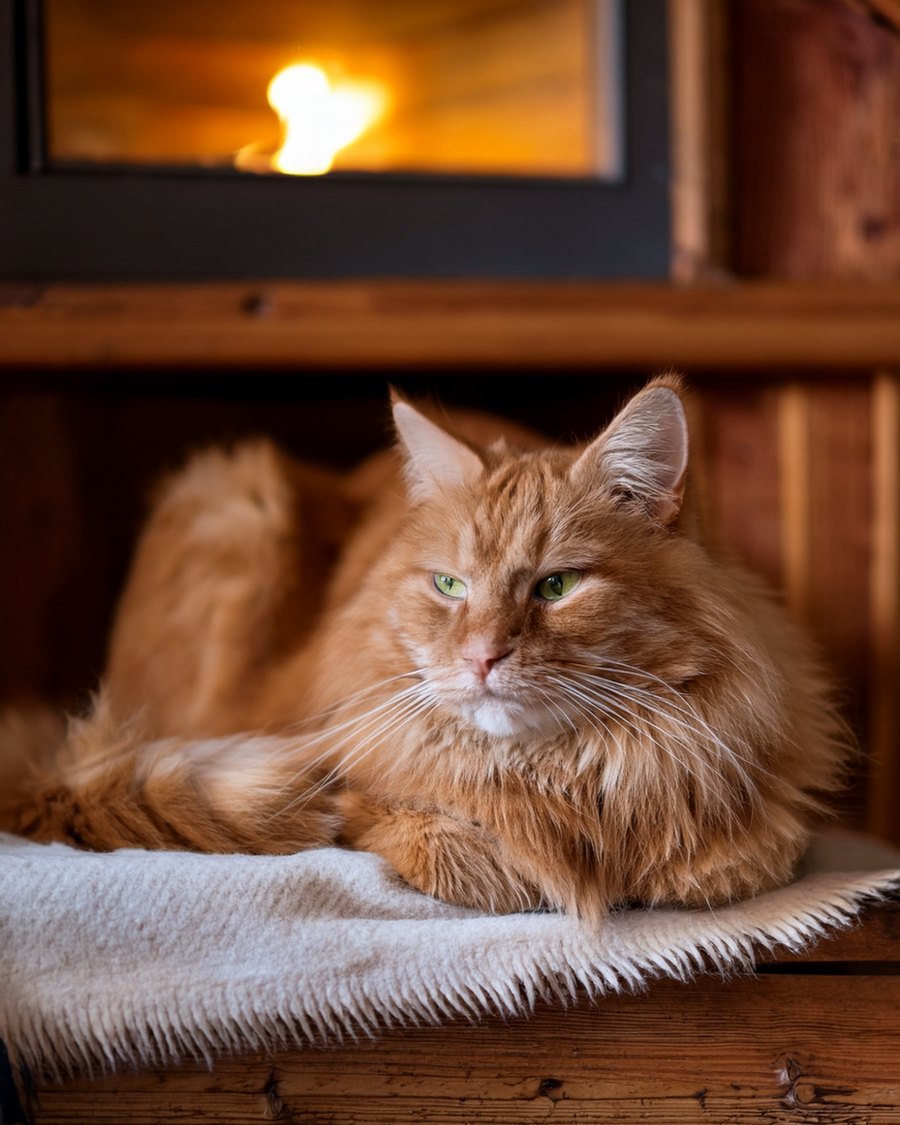
One colour belongs almost to her alone. In the 1990s, kittens were born in Sweden that at first looked like black or brown tabby forest cats. With every month their coats grew warmer, until as adults they glowed in a golden, honeyed tone. The colour was named amber. In 2009 researchers found the cause: a variant in the MC1R gene that gradually replaces dark pigment with light (Peterschmitt et al., 2009). A cat whose colour reveals itself slowly, like a photograph developing in the dark.
 AI-generated
A word on health
The forest cat is a sturdy breed, and as with every breed, a few inherited conditions are well studied. Glycogen storage disease type IV (GSD IV) is very rare and recessively inherited. Since its cause in the GBE1 gene was identified, a DNA test lets responsible breeders rule it out reliably (Fyfe et al., 2007). A pedigree study of 871 forest cats also points to a familial tendency towards cardiomyopathy, changes in the heart muscle (März et al., 2015). Good breeders therefore screen their cats with DNA tests and heart scans, and your vet will know which check-ups suit your cat.
Made for big cats
A cat who can weigh up to nine kilograms and loves to stretch to her full length needs things that grow with her. Here are four we chose for you. Every link goes straight to the product described on Amazon. We don't list prices, because they change all the time.
A trunk that doesn't sway: the Prestige Cat Trees Main Coon Cat House (#ad). A tree designed for cats of Maine Coon size, with a house to curl up in and perches for the long view.
For the view from the very top: the Globlazer Heavy Duty Cat Tree S72 (#ad). Six feet tall with six scratching posts and a hammock, designed for cats of 20 pounds and more. A lookout worthy of a climber.
Room to turn around: the Smart Paws Extra Large Jumbo Litter Box (#ad), open-topped with high sides. Big cats prefer a box they can turn around in without brushing the walls.
For the undercoat: a stainless-steel greyhound comb with rounded teeth (#ad). It glides through long fur and lifts small tangles before they become mats. She'll love it most in spring, when the winter wool lets go.
If big breeds are your love, you'll also enjoy our portrait of the Maine Coon, America's answer to the same cold.
What remains
We can trace her coat back to the snow, her colour to a single gene and her rescue to a cat named Pans Truls. What no one can explain is the moment she sits beside you at the window and gazes out into the dusk, as if she could see something hidden from you. A forest that is long gone, perhaps. A chariot over the fjords. Who could say for sure.
Read next: What the slow blink actually says
Sources
- Fédération Internationale Féline (FIFe) — Breed profile Norwegian Forest Cat (NFO). fifeweb.org.
- Cat-o-pedia (2022). The Norwegian Forest Cat (breed history: Pans Truls 1973, FIFe recognition 1977, first US import 1979). cat-o-pedia.org.
- Bessant, C. & Cutts, P. (1999). The Complete Guide to the Cat. London: Barron’s. (Skogkatt in Norwegian folklore, coat structure.)
- Peterschmitt, M., Grain, F., Arnaud, B., Deléage, G. & Lambert, V. (2009). Mutation in the melanocortin 1 receptor is associated with amber colour in the Norwegian Forest Cat. Animal Genetics, 40(4), 547–552.
- Fyfe, J. C., Kurzhals, R. L., Hawkins, M. G. et al. (2007). A complex rearrangement in GBE1 causes both perinatal hypoglycemic collapse and late-juvenile-onset neuromuscular degeneration in glycogen storage disease type IV of Norwegian forest cats. Molecular Genetics and Metabolism, 90(4), 383–392.
- März, I., Wilkie, L. J., Harrington, N. et al. (2015). Familial cardiomyopathy in Norwegian Forest cats. Journal of Feline Medicine and Surgery, 17(8), 681–691.
- UC Davis Veterinary Genetics Laboratory — Glycogen Storage Disease Type IV in Norwegian Forest Cats; Amber Coloration in Norwegian Forest Cats. vgl.ucdavis.edu.
General information, not veterinary advice. The cat photos on this site are AI-generated.