The Maine Coon: a cat built by winter
Snowshoes between her toes, a scarf of fur at her throat, a tail long enough to sleep inside: the Maine Coon was shaped by the long winters of New England. A portrait of a gentle giant who greets you with a chirp, and of the legends that have followed her ever since.
 AI-generated
Picture a farmhouse on the coast of Maine, sometime in the nineteenth century, on a January morning when the snow has drifted halfway up the barn door. The light is blue and thin, the cows are steaming in their stalls, and on a beam above them a large brown tabby is waking up. She unwinds the great plume of her tail from around her face, stretches each broad paw until the tufts between her toes fan out like feathers, and drops without a sound into the straw. Then she makes a small, bright noise, half chirp and half question, and walks out into the white.
That cat had no papers and no breed name. She had something older: a body that the winter itself had been shaping, generation after generation, long before anyone thought to write a standard for her.
A cat out of legend
Where she came from, nobody knows for certain, and the stories people have told to fill that silence are among the loveliest in the cat world. The oldest is hidden in her name. Her ringed, bushy tail and brown tabby coat reminded some of a raccoon, and so the tale grew that she was half wild creature — a romance biology does not allow, but one that gave her the second half of her name and has stayed faithfully at her side ever since.
Another legend places her aboard the ship of Captain Samuel Clough, who is said to have planned to carry Marie Antoinette out of revolutionary France. The queen never came aboard. Her six long-haired cats, so the story goes, sailed on without her to Wiscasset, Maine, and stayed. A third tale tells of an English sea captain named Coon, whose long-haired ship’s cats went ashore in every harbour and left kittens behind. And some like to picture her ancestors further back still, curled among the ropes of Viking ships that crossed the North Atlantic centuries before Columbus.
None of these can be proven, and that is part of their spell. What the record suggests is simpler and no less beautiful: short-haired cats who arrived with the early settlers met long-haired cats brought by seafarers, and the New England winters did the rest, favouring the sturdiest and best-coated, year after year. Genetic studies place the Maine Coon in the western European branch of cats, closest to the random-bred cats of the north-eastern United States (Lipinski et al., 2008). Her likeness to the Norwegian Forest Cat is probably less a family tie than two answers to the same cold.
A body written by winter
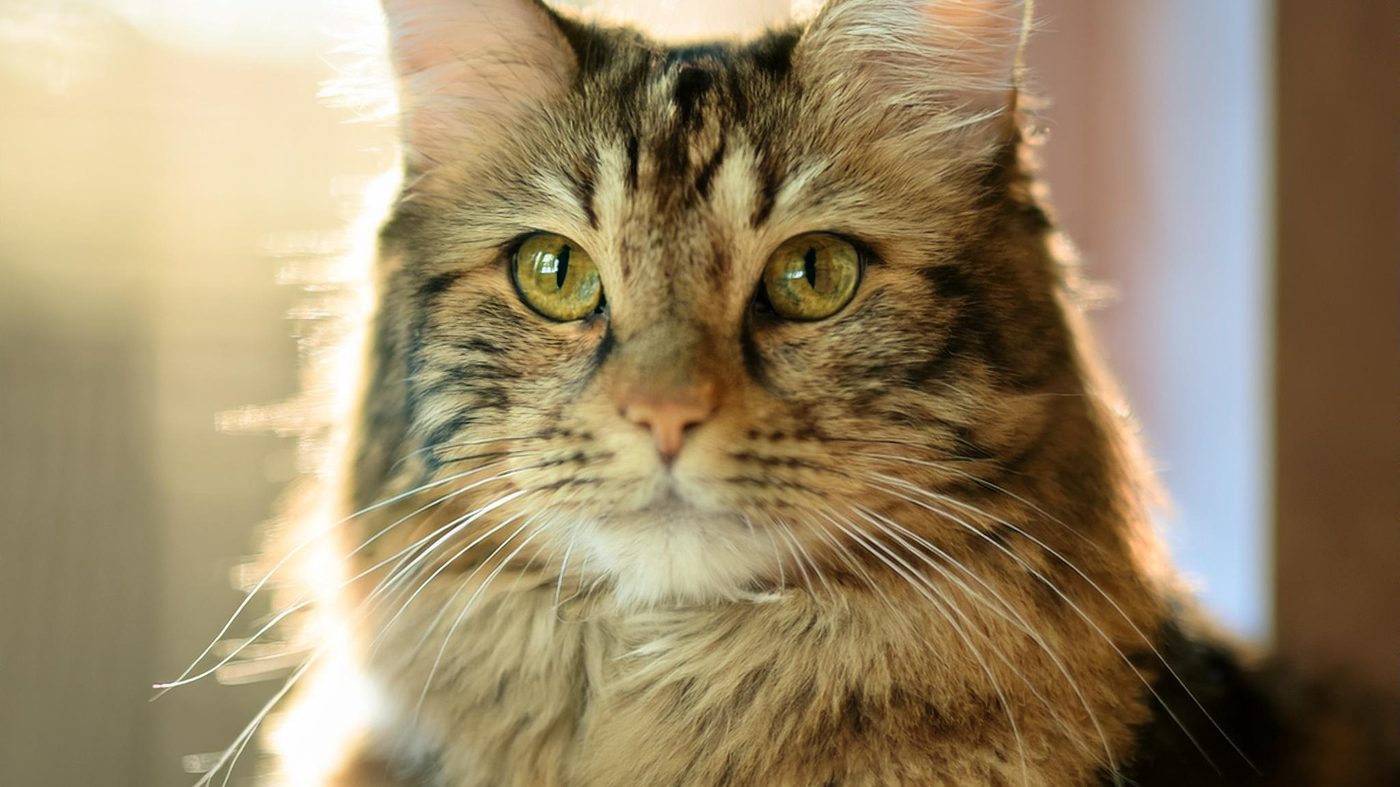
Look at her slowly and you can read the climate in her like a map. The paws are large and round, and the long tufts between her toes spread her weight across soft snow the way snowshoes do, while keeping the pads warm. Her coat is a garment cut with care: shorter over the shoulders, where it would only tangle, long and shaggy on the belly and hind legs, where a cat sits on ice and wades through drifts. The outer hairs let water run off; beneath them lies a dense, soft undercoat. At her throat the fur gathers into a ruff, a scarf she never takes off.
And then the tail, perhaps her most extravagant gift. Long, full and ringed, it wraps around her face and shoulders while she sleeps, a blanket against the wind that she carries everywhere. On the tips of her ears stand tufts like a lynx’s, and the insides are lined with fur against the cold. You may catch her doing all of this on a warm afternoon in August, drawing that tail over her nose on your sofa, out of a habit older than any central heating.
The gentle giant
For all her size, she is famous for a gentleness that takes people by surprise the first time they meet her. The Cat Fanciers’ Association describes the breed as gentle and loyal, at ease with children and dogs. She speaks less in meows than in trills and chirps, a soft, rising voice that sounds like a greeting even when she is only remarking on the weather.
Many people who share their homes with a Maine Coon tell of her fascination with water: a paw dipped into the drinking bowl, a long, absorbed watch beside the dripping tap, a visit to the bathroom whenever the bath is running. The story is told so often that it has become part of her portrait, though no study has yet measured it. And she loves to be near her people. Not always on your lap, but beside you, in the same room, on the cushion next to yours, following you from kitchen to study as if your company were simply the natural place to be.
A slow unfolding
She takes her time growing up. Where most cats reach their adult size at around a year, a Maine Coon often keeps filling out for three or four years, sometimes five, her frame broadening and her ruff thickening winter by winter. Living with her means watching a slow unfolding: a kitten’s playfulness lingering inside a body that keeps on becoming more magnificent.
The first queen of the show
In May 1895, at the National Cat Show in New York’s Madison Square Garden, one of the first great cat shows in America, a brown tabby female named Cosey was crowned best in show. She won a silver collar and a silver medal engraved “National Cat Show, 1895”. Both have survived and are kept today at the Feline Historical Museum in Alliance, Ohio. Decades later, after the breed had all but vanished from the show halls, the Maine Coon returned. She was granted championship status by the CFA in 1976, and in 1985 she became the official state cat of Maine. The farm cat from the snowy coast had come home with every honour.
A word on health
Like many large breeds, the Maine Coon has a few health themes that are well understood. A form of hypertrophic cardiomyopathy (HCM), a thickening of the heart muscle, has been studied in the breed since the late 1990s (Kittleson et al., 1999), and in 2005 researchers identified a variant in the MYBPC3 gene associated with it (Meurs et al., 2005). Not every cat who carries the variant goes on to develop the condition (Godiksen et al., 2011). Hip dysplasia is also known in the breed (Loder & Todhunter, 2018; Low et al., 2019). Responsible breeders have their cats checked with a gene test, heart ultrasound and hip X-rays, and your vet can tell you which check-ups suit your cat best.
What remains
We can trace her coat back to the snow and her name back to a story, and we can count the years she needs to grow into herself. What we cannot quite explain is the feeling when a cat this large settles down beside you, wraps that magnificent tail around her paws and greets you with a small, bright trill. Some of her the winter made. The rest, it seems, she brought with her.
Read next: The Norwegian Forest Cat: a cat from the forests of legend
Sources
- Cat Fanciers’ Association (CFA) — Breed article: America’s First Show Cat – The Maine Coon Cat. cfa.org.
- Feline Historical Foundation — Cosey’s Collar (National Cat Show, Madison Square Garden, 1895). felinehistoricalfoundation.org.
- Maine Revised Statutes, Title 1, §217 — State cat.
- Lipinski, M. J. et al. (2008). The ascent of cat breeds: Genetic evaluations of breeds and worldwide random-bred populations. Genomics, 91(1), 12–21.
- Kittleson, M. D., Meurs, K. M., Munro, M. J. et al. (1999). Familial hypertrophic cardiomyopathy in Maine Coon cats: an animal model of human disease. Circulation, 99, 3172–3180.
- Meurs, K. M., Sanchez, X., David, R. M. et al. (2005). A cardiac myosin binding protein C mutation in the Maine Coon cat with familial hypertrophic cardiomyopathy. Human Molecular Genetics, 14, 3587–3593.
- Godiksen, M. T. N., Granstrøm, S., Koch, J. & Christiansen, M. (2011). Hypertrophic cardiomyopathy in young Maine Coon cats caused by the p.A31P cMyBP-C mutation – the clinical significance of having the mutation. Acta Veterinaria Scandinavica, 53, 7.
- Loder, R. T. & Todhunter, R. J. (2018). Demographics of hip dysplasia in the Maine Coon cat. Journal of Feline Medicine and Surgery, 20, 302–307.
- Low, M., Eksell, P., Högström, K. et al. (2019). Demography, heritability and genetic correlation of feline hip dysplasia and response to selection in a health screening programme. Scientific Reports, 9, 17164.
General information, not veterinary advice. The cat photos on this site are AI-generated.