Freyja's cats · Scandinavia
When the goddess Freyja travels, so an old Icelandic book tells us, she sits in a chariot drawn by two cats. A single sentence, eight hundred years old — and the image has never quite let us go.
 AI-generated
Picture a winter night in the far north, one of those nights when the sky seems closer than the sea. Somewhere above the fjords a chariot is travelling, and the one who sits in it is the most radiant of all the goddesses — golden, so it is said, and when she grieves she weeps tears of red gold. No horses run before her. No wolves, no goats, no eagles. Two cats.
That image has come a long way to reach us. It was written down in Iceland around 1220 by the poet and historian Snorri Sturluson, more than two hundred years after Iceland had accepted Christianity. Snorri gathered the old tales of the gods so that later generations of poets would still understand the images woven through the ancient verses. Among the world-tree and the end of the world, among giants, dwarves and gods, he set down one small sentence about cats.
What the old book says
In the part of the Prose Edda called Gylfaginning — roughly, “the deluding of Gylfi” — a king in disguise asks questions about the gods, and three mysterious figures answer him. When they come to Freyja, he learns that she owns a hall called Fólkvangr, that half of those who fall in battle are hers, and that it is good to call on her in matters of love. And then, almost in passing: when she travels, “she drives two cats and sits in a chariot” (Faulkes, 1987).
That is very nearly all. Much later in the same book, when the gods gather for the funeral of Baldr, the shining one, Freyja appears once more, and once more she is driving her cats. In the language of skaldic poetry she may be called the owner of the tom-cats. The cats themselves have no names. No colour, no size, no voice. Snorri gives them one line and moves on, the way one might mention the colour of a cloak.
It is only honest to say it plainly: this is everything the medieval sources give us. All the rest came later.
How the silence was filled
A sentence so brief leaves a great deal of room, and people have filled it with devotion ever since. In retelling after retelling, Freyja’s cats have become great grey creatures, or something close to lynxes, or the long-haired forest cats of the north. In 1984 the American author Diana L. Paxson even gave them names in her novel Brisingamen: Bygul and Trjegul. The names fit so beautifully that many people now believe them ancient. They are not. They are a gift from our own time to a very old story — and there is something lovely in that, because it means the legend is still being told.
Who she was
Freyja belongs to the Vanir, the gods of fertility and abundance. She is the goddess of love and of beauty, and of something wilder too. In another of Snorri’s works, the Ynglinga saga, it is said that she brought seiðr to the gods, a magic for perceiving what lies hidden. The famous necklace Brísingamen is hers, and so is a cloak of falcon feathers in which one can fly. When her husband Óðr wanders far away, she weeps for him, and her tears are red gold. She is not simply gentle. She is everything at once.
Why cats?
No one knows. The old text does not explain, and scholarship has never settled the question. Perhaps it does not need settling. Think for a moment about what the image holds. Thor’s chariot is drawn by two goats, Odin rides an eight-legged horse — animals that can be guided and steered. Freyja travels with the one creature that has never been made to do anything at all. Her cats draw her chariot because they wish to. That, at least, is how we like to read the line, and it may be the most enchanting sentence Snorri ever wrote.
What remains
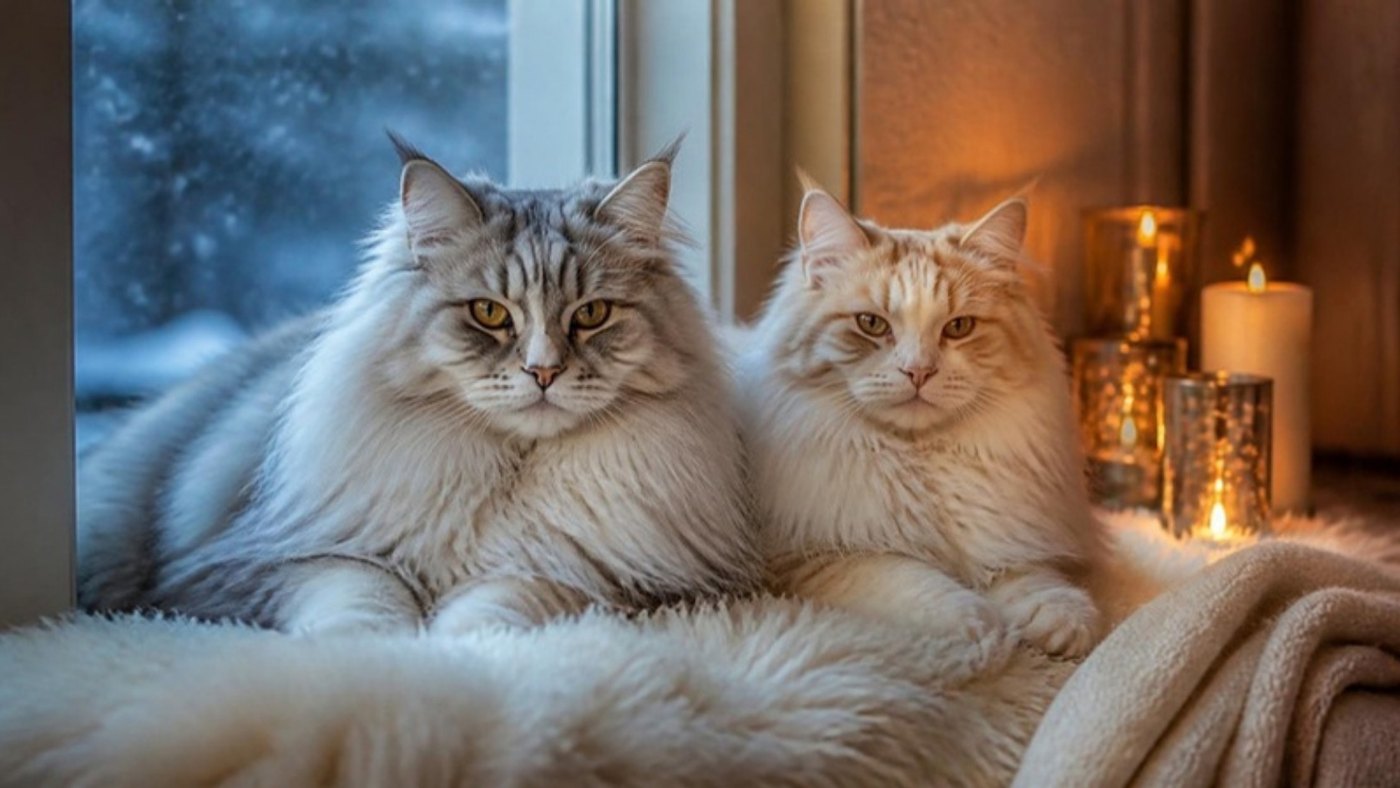
Look at the two cats at the top of this page, gazing out as though a journey were about to begin. They have never heard of Freyja. And yet they do what her cats did. They come along when they decide to. They walk ahead of you down the hall with their tails held high, and they settle beside you as if they had been sitting there for a thousand years. Perhaps that is why the old sentence still carries. Anyone who has ever been chosen by a cat knows a little of what it must be like to travel beside a goddess.
And who can say whether, on some clear winter night, a chariot still crosses the fjords, drawn by two cats who go only where they themselves choose to go.
Read next: The beckoning cat · Japan
Sources
- Snorri Sturluson. Edda. Translated and edited by Anthony Faulkes. London: J. M. Dent (Everyman), 1987. Gylfaginning (Freyja and her cats, p. 24; Baldr’s funeral, p. 50) and Skáldskaparmál (kennings for Freyja, p. 86).
- Snorri Sturluson. Heimskringla: History of the Kings of Norway. Translated by Lee M. Hollander. Austin: University of Texas Press, 1964. Ynglinga saga, ch. 4 (Freyja and seiðr).
- Paxson, D. L. (1984). Brisingamen. New York: Berkley. (Source of the modern names Bygul and Trjegul, which do not appear in the medieval texts.)
- Germanic Mythology: Texts, Translations, Scholarship — “Freyja’s fressa”, a collection of the Old Norse passages on Freyja’s cats with translations (germanicmythology.com).
The cat photos on this page are AI-generated.