The Siamese Cat: the moon diamond of old Siam
A pale body like moonlight, points that look brushed on in ink, and eyes of a blue you never quite forget: the Siamese comes to us from the old cat books of Siam. A portrait of the cat who talks back.
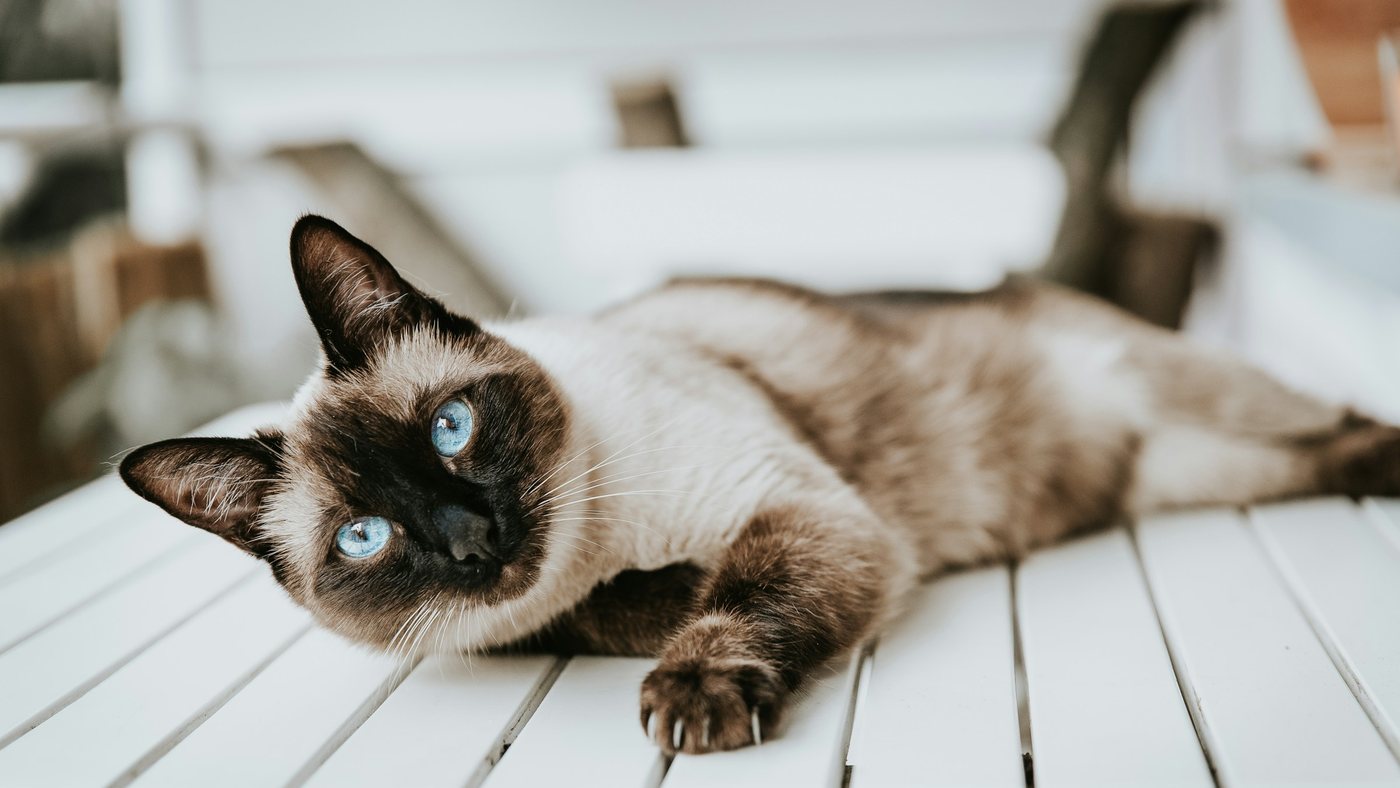 Photo: Unsplash
Picture an evening by a river in Siam, long ago. The heat of the day still hangs over the water, lanterns shiver on the current, and on the threshold of a wooden house sits a slender, pale cat. Her body glows like ivory in the last of the light. Only her face, her ears, her paws and her tail are dark, as if someone had dipped her gently in ink. Then she turns her head and you see her eyes, a deep, clear blue. She looks at you and says something. Not an ordinary meow. More like a question.
In Thailand this cat is called Wichien Maat, a name usually rendered as “moon diamond.” It sounds like something out of a fairy tale, and perhaps that is exactly what it is.
A cat from the old books
Long before there were cat shows, artists in Siam painted cats into folding books of paper. These manuscripts are known as Tamra Maew, treatises on cats. In soft watercolors they show the cats believed to bring good fortune, and beside each painting runs a verse describing how to recognize her. Of the moon diamond, the lines say, more or less: the muzzle, the tail, four paws and two ears, eight points of purest black (Clutterbuck, 2008). Look at a Siamese today and you will find her in those words at once.
How old the verses are, no one can say for sure. Tradition places them in the kingdom of Ayutthaya, which lasted from 1351 to 1767. But when the old capital was destroyed in 1767, countless writings were lost, and every manuscript we know today was made afterward, once the kingdom had been reestablished from 1782 on (Clutterbuck, 2008). A lovely copy in the British Library is dated to the nineteenth century. It bears no name and no date. Perhaps the verses were copied through many generations, hand to hand, like a song passed down. Perhaps they are younger than the legend would like. That blur is part of what makes them so precious.
The voyage west
In July 1871 the Crystal Palace in London hosted the first great cat show. Among the entries, according to the cat historian John G. Smithson, was a pair of Siamese shown by a Mr. Maxwell. Whether they were Siamese in today’s sense is hard to say. The arrival of 1884 is better documented: Edward Blencowe Gould, the British consul-general in Bangkok, brought a pair home to England as a gift for his sister Lilian. Their kittens were shown at the Crystal Palace in 1885, and in 1901 Lilian Gould helped found the Siamese Cat Club. Across the Atlantic, a Siamese named Siam had already arrived in 1878, a gift to President Rutherford B. Hayes.
For a long time there was only one color, seal, a warm brown so deep it is nearly black. The Cat Fanciers’ Association (CFA), which has registered the breed since its own founding in 1906, went on to recognize blue point in 1934, chocolate point in 1952 and lilac point in 1955.
A color that follows the warmth
The secret of her markings lies in a single enzyme. Tyrosinase helps the body make pigment. In the Siamese, the TYR gene carries one tiny change, the cs variant, discovered independently by two research teams in 2005 (Lyons et al., 2005; Schmidt-Küntzel et al., 2005). This version of the enzyme only works well where the body runs a little cooler. Over the warm core of the body the coat stays pale. On the ears, paws, tail and face, it darkens.
That is why Siamese kittens are born almost white. In the womb, everything was equally warm. Only after birth do the extremities cool a little, and week by week the points appear, as though they were rising slowly from within. As the years pass, the cooler areas often grow darker still (Langley, 2023). Here is a cat whose coat is a map of her own body heat, drawn in light and shadow.
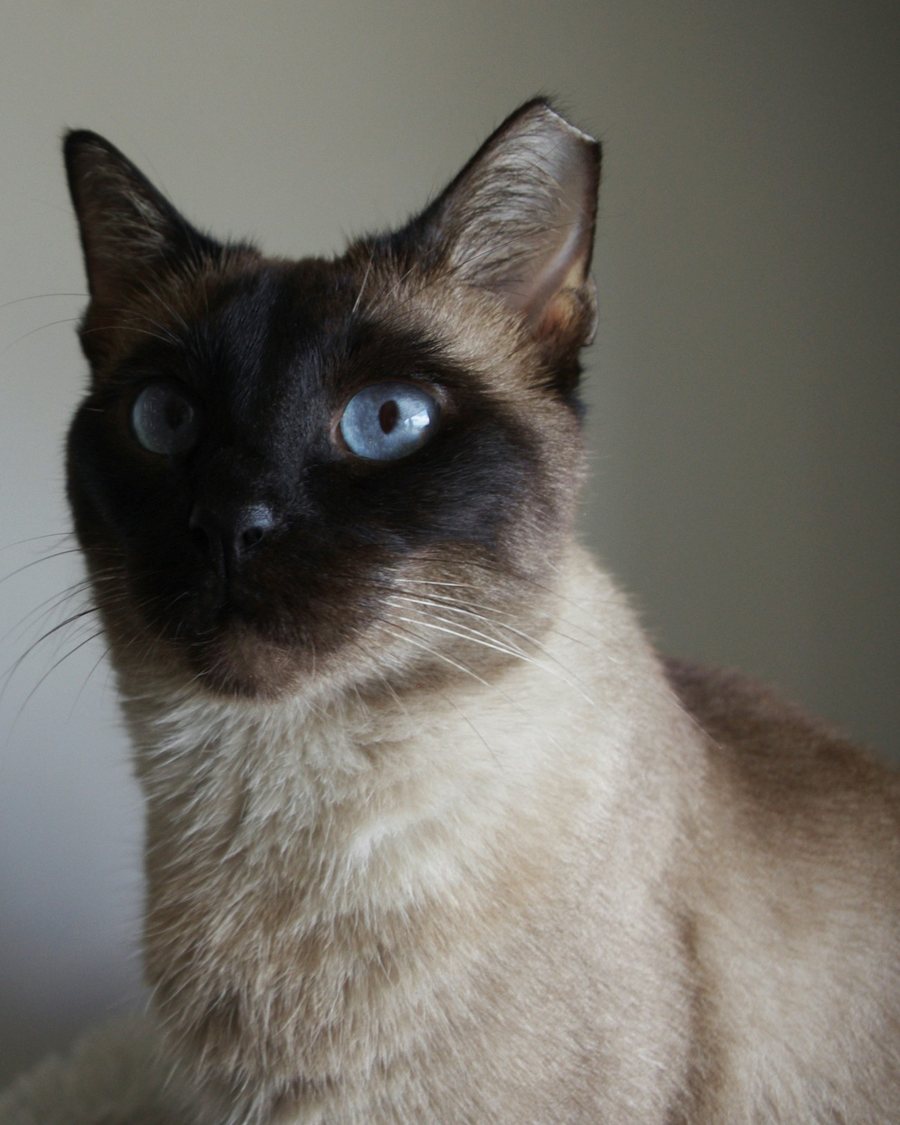 Photo: Unsplash
A voice with something to say
Life with a Siamese is rarely silent. The CFA calls the breed unsurpassed in its ability to communicate with people, with a large repertoire of sounds and expressive body language to match. She comments, she asks, she calls to you from the next room, and when you answer, she answers back. Some of her calls can sound remarkably like a human baby. For the quieter things cats say, read Why cats purr.
Her voice comes from a deep devotion. Siamese are known as loving companions who want to be part of whatever you are doing. Many bond especially closely with one person and stay loyal with their whole heart. They seek out warmth, ideally your lap, and the CFA notes with a wink that they love you partly because you are warm. A cat who wants this much closeness is glad of company when her people are away for long stretches, perhaps a second cat at her side.
Two faces of one breed
In old photographs, Siamese have rounder heads and sturdier bodies than many Siamese do today. From around 1950, an ever slimmer, longer type came to dominate the show ring, and by the mid-1980s the original look had all but vanished from it. The CFA standard today describes a medium-sized, svelte cat of long, flowing lines, with a wedge-shaped head, large ears and almond-shaped eyes of vivid blue.
Yet the older form was never lost. In the late 1980s, breeders in Europe and North America set out to preserve the original Siamese, drawing partly on cats from Eastern Europe, where the early type had survived. They named it the Thai, after the country’s modern name. The World Cat Federation (WCF) granted it full championship status in 1990, and around 2000 cats from Thailand itself joined the lines. Two faces, one origin. Both wear the same eight dark points described in the old verses.
A word on health
Many early Siamese had a slight squint or a kink in the tail. Breeders later came to see both as faults, and careful breeding has made them far less common. Today the CFA standard calls for uncrossed eyes, and a visible tail kink disqualifies a cat in the show ring.
One inherited eye condition has also been studied closely: progressive retinal atrophy, known as rdAc. It is recessively inherited and appears later in life. The responsible variant in the CEP290 gene was first found in Abyssinians (Menotti-Raymond et al., 2007). Later work showed it occurs in many breeds and was comparatively common in Siamese populations in North America and Europe (Menotti-Raymond et al., 2010). A DNA test now lets responsible breeders make sure no affected kittens are born, so it is worth asking about the parents’ results. Your vet will know which check-ups suit your cat.
What remains
We can trace her markings to a single enzyme, her voyage to a consul in Bangkok and her look to eight dark points in a folded book. What no one can explain is the moment she looks at you in the evening, with eyes as blue as water in shadow, and tells you something you cannot translate. Lanterns on a river, perhaps. A book whose first page no one remembers. You don’t understand the words. But you know exactly that she is talking to you.
Read next: What the slow blink actually says
Sources
- Clutterbuck, M. (2008). Inventory: Auspicious Cats. Cabinet, 30 (Summer 2008). cabinetmagazine.org. (Tamra Maew: traditionally dated to the Ayutthaya period 1351–1767, surviving manuscripts from 1782 onward; verse on the eight dark points of the Wichien Maat.)
- The Public Domain Review — The Cat’s Maew: Thai Treatise on Auspicious Felines (19th Century). publicdomainreview.org. (Wichien Maat, “moon diamond.”)
- Library of Congress — Treatise on Cats [1800–1899]. Digital copy of British Library manuscript Or 16797. loc.gov/item/2021668043.
- Cat-o-pedia (2020). Felis Historica: Tachin (after J. G. Smithson, An Historical Portrait of Seal Point Siamese; Siamese shown by Mr. J. Maxwell at the Crystal Palace show of July 1871). cat-o-pedia.org.
- Governing Council of the Cat Fancy (GCCF) — Breed profile Siamese (Gould 1884, Crystal Palace 1885, Siamese Cat Club 1901, temperament and voice). gccfcats.org.
- Cat Fanciers’ Association (CFA) — Breed profile Siamese (Hayes 1878, CFA 1906, color recognitions, temperament and voice) and Siamese Show Standard (rev. 2026). cfa.org.
- World Cat Federation (WCF) — Breed description Thai (change of type from about 1950, Thai breeding program, championship status 1990). wcf.de.
- Lyons, L. A., Imes, D. L., Rah, H. C. & Grahn, R. A. (2005). Tyrosinase mutations associated with Siamese and Burmese patterns in the domestic cat (Felis catus). Animal Genetics, 36(2), 119–126.
- Schmidt-Küntzel, A., Eizirik, E., O’Brien, S. J. & Menotti-Raymond, M. (2005). Tyrosinase and tyrosinase related protein 1 alleles specify domestic cat coat color phenotypes of the albino and brown loci. Journal of Heredity, 96(4), 289–301.
- Langley, L. (2023, October 27). How Siamese cats change their colors. National Geographic. nationalgeographic.com.
- VCA Animal Hospitals — Siamese (breed profile: squint and tail kinks more common in earlier generations, voice). vcahospitals.com.
- Menotti-Raymond, M., David, V. A., Schäffer, A. A. et al. (2007). Mutation in CEP290 discovered for cat model of human retinal degeneration. Journal of Heredity, 98(3), 211–220.
- Menotti-Raymond, M., David, V. A., Pflueger, S. M. et al. (2010). Widespread retinal degenerative disease mutation (rdAc) discovered among a large number of popular cat breeds. The Veterinary Journal, 186(1), 32–38.
- UC Davis Veterinary Genetics Laboratory — Colorpoint Restriction; Progressive Retinal Atrophy (PRA rdAc). vgl.ucdavis.edu.
General information, not veterinary advice. Photos: Unsplash.