Why cats purr
It is one of the most familiar sounds in any home with a cat, and one of the least understood. Science has measured it, recorded it, even coaxed it from a larynx in the laboratory — and the purr has kept its secret.
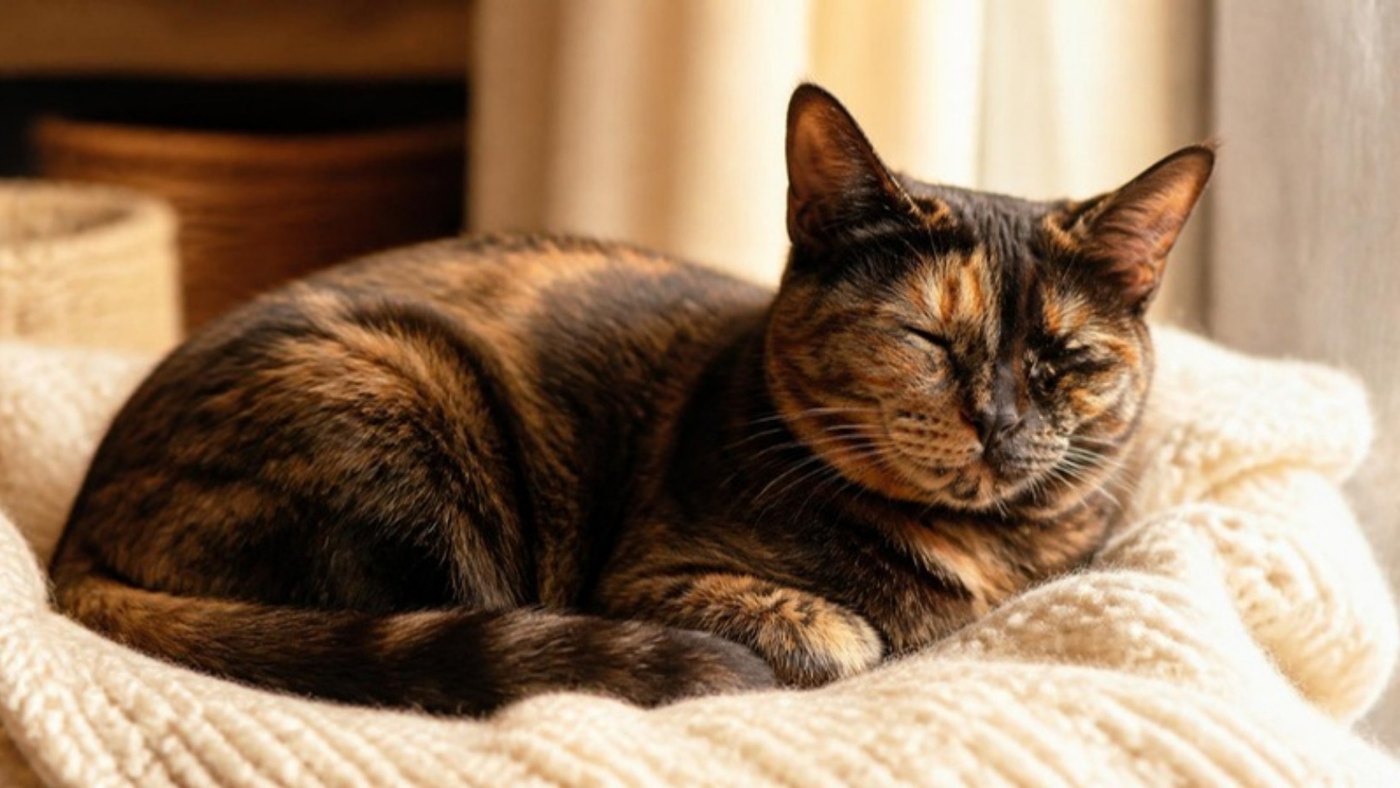 AI-generated
It starts before you notice it. She has settled against your hip, the lamp is low, and somewhere under your hand a small engine turns over — not loud, more felt than heard, a warm rolling hum that seems to come from everywhere in her at once. Your own breathing slows to meet it. Neither of you moves. Of all the sounds a cat can make, this is the one she keeps for the very closest distance.
People have loved that sound for as long as cats have lived beside us. What is less well known is how hard it has been to explain — how she makes it, and why.
What the research heard
The purr is made in the larynx, breathing in and breathing out. Recordings from the 1970s and early 1990s traced the sound to the voice box: the vocal folds close and open many times a second, and the air gathering at the briefly closed glottis and rushing free sets everything vibrating (Remmers & Gautier, 1972; Frazer Sissom et al., 1991). Unlike a meow, the purr does not stop between breaths. It runs on as she breathes in and as she breathes out, which is why it can seem to have no beginning and no end.
Its rhythm is astonishingly deep. A domestic cat purrs at around twenty to thirty vibrations a second — lower than the lowest string of a cello, from vocal folds no bigger than a fingernail. In 2023, a team in Vienna examined the larynges of eight cats in the laboratory and passed air through them. With no signal from the brain and no muscle contracting, the tissue began to vibrate at purring frequencies (Herbst et al., 2023). Inside the vocal folds the researchers found small pads of soft connective tissue, up to four millimetres across, which may be what lets so small an instrument play so low a note. The older explanation — a rhythmic signal from the brain driving the laryngeal muscles — is not ruled out. It simply no longer seems to tell the whole story.
Every wild cat studied purred across a wide band. An acoustic survey of 44 animals from five species — cheetahs, ocelots, pumas, servals and domestic cats — reported strong frequencies between 25 and 150 Hz in all of them (von Muggenthaler, 2001). The author went further: because some of these frequencies resemble those used in vibration therapy, the purr might help bone and tissue to heal. It is a beautiful idea. It was presented as a conference abstract, has not been tested in cats, and remains a hypothesis.
Some purrs carry a hidden cry. At the University of Sussex, Karen McComb’s team asked owners to record their cats purring in two moments: while asking for breakfast, and while calm and wanting nothing. Woven into the low hum of the asking purr was a high, voiced sound, in a frequency range close to that of a human infant’s cry. Fifty listeners heard these purrs as more urgent and less pleasant — even people who had never lived with a cat — and when the hidden cry was filtered out, the urgency faded (McComb et al., 2009). She seems to have found a way to speak to the oldest part of our attention.
A purr is more than contentment. Kittens purr almost from birth, while they suckle. Cats have been seen purring while giving birth, and now and then when they are unwell or in pain (Chaire bien-être animal, VetAgro Sup, 2022). Veterinary experts count purring among the behaviours that can appear in a cat in pain, but call it rare and not telling on its own (Merola & Mills, 2016). So the purr seems less like a single message than a way of being close — to another cat, to a person, perhaps to herself.
Listening for yourself
Next time she settles against you, rest your palm flat along her side, or your cheek near her neck, and close your eyes. Notice where the purr is strongest — throat, chest, flank. Notice whether it changes when your hand goes still, or as she drifts towards sleep. And if the morning purr beside the food bowl sounds a shade more insistent than the evening one under the lamp, you are hearing exactly what the listeners in Sussex heard. Your ear is right.
What stays a mystery
We know where the purr is made, roughly how fast it runs, and that it can carry a request inside it. Why it evolved, and what it feels like from within — whether it soothes her the way it soothes us — nobody knows for certain. Those questions are still open. That part belongs to her.
Research suggests; it does not prove. The laryngeal study examined eight cats, the solicitation-purr study recorded ten, and the frequency survey is a conference abstract rather than a peer-reviewed paper. Small numbers, careful findings, many open questions.
Read next: What the slow blink actually says
Sources
- Remmers, J. E. & Gautier, H. (1972). Neural and mechanical mechanisms of feline purring. Respiration Physiology, 16(3), 351–361.
- Frazer Sissom, D. E., Rice, D. A. & Peters, G. (1991). How cats purr. Journal of Zoology, 223(1), 67–78.
- Herbst, C. T., Prigge, T., Garcia, M., Hampala, V., Hofer, R., Weissengruber, G. E., Švec, J. G. & Fitch, W. T. (2023). Domestic cat larynges can produce purring frequencies without neural input. Current Biology, 33, 4727–4732.
- von Muggenthaler, E. (2001). The felid purr: A healing mechanism? Journal of the Acoustical Society of America, 110, 2666 (meeting abstract).
- McComb, K., Taylor, A. M., Wilson, C. & Charlton, B. D. (2009). The cry embedded within the purr. Current Biology, 19(13), R507–R508.
- Chaire bien-être animal, VetAgro Sup (2022). A purring cat is a happy cat: true or false? Fact sheet (chaire-bea.vetagro-sup.fr).
- Merola, I. & Mills, D. S. (2016). Behavioural signs of pain in cats: an expert consensus. PLoS ONE, 11(2), e0150040.
General information, not veterinary advice. The cat photos on this page are AI-generated.