The European House Cat: the cat who stayed
Striped like a field at dusk, with eyes like amber and a family tree that reaches back some ten thousand years: the European house cat is not a breed, yet her story is the oldest of all. A portrait of the cat who lives in so many of our homes.
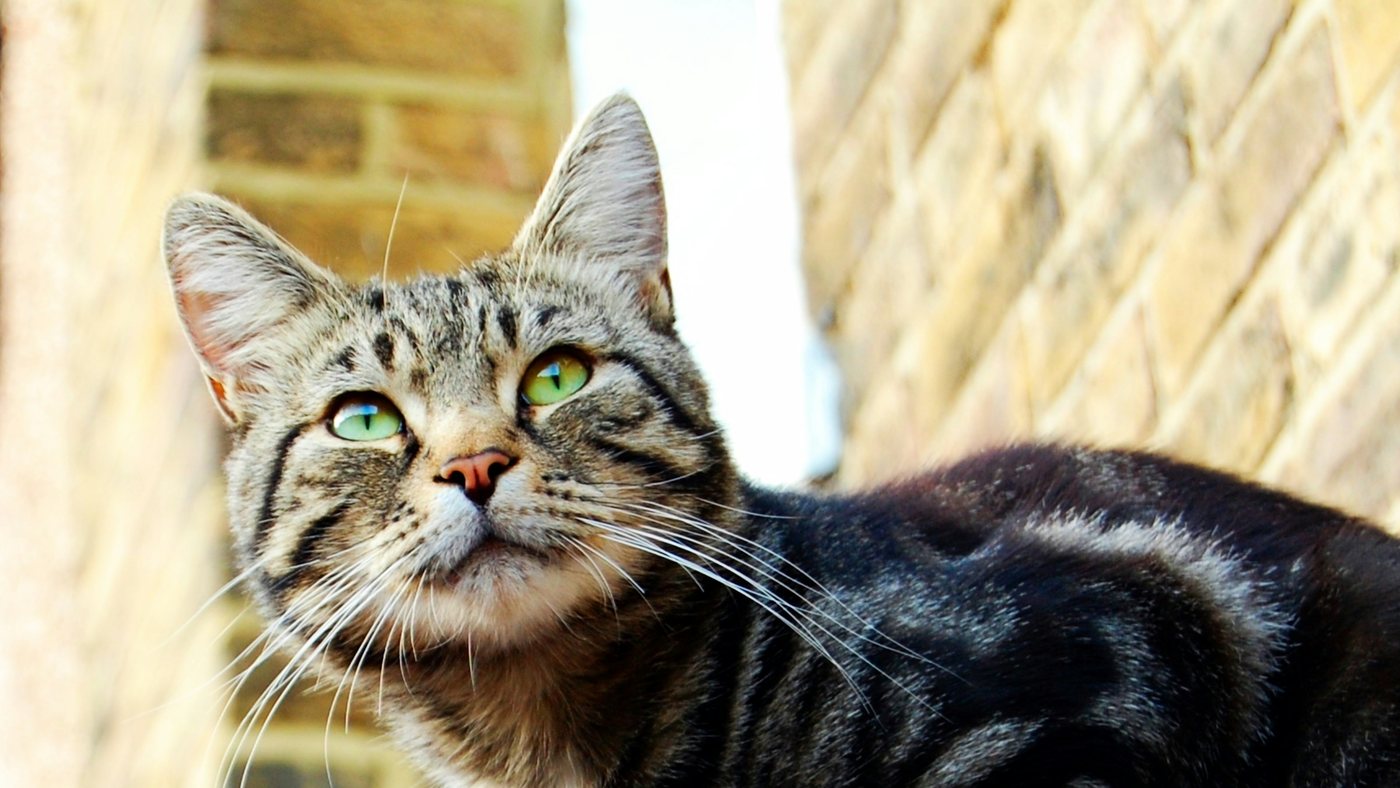 Photo: Unsplash
Picture a farmyard at the edge of a village on a late-summer evening. The hay is in, the swallows are flying low, and on the warm stone in front of the barn lies a tabby cat. Her coat holds the colors of the fields, brown and gray and a touch of gold, threaded with dark stripes. She gives you a slow blink and doesn’t move. She belongs here as naturally as the old linden by the gate. And yet she has come a very long way.
The European house cat is not a breed in the strict sense. She has no pedigree, no standard and no famous founding tom. She is simply the cat who lives with us, in farmhouses and city apartments and on sunny windowsills. That is exactly why she deserves a portrait. Her story is the oldest of them all.
A wildcat who stayed
Her ancestor is the African wildcat, Felis silvestris lybica, a wild cat of the Near East. When researchers compared the DNA of nearly a thousand domestic and wild cats, the trail led to the Fertile Crescent, where people first built villages and planted grain (Driscoll et al., 2007). It is easy to imagine how it began. The grain stores drew mice, the mice drew wildcats, and some of the wildcats stayed. No one tamed her the way one breaks a horse. She came, and she chose to stay.
How early that closeness began is told by a grave on Cyprus. At the Neolithic village of Shillourokambos, archaeologists uncovered a human burial about 9,500 years old, and just 40 centimeters (16 inches) away the skeleton of a cat about eight months old (Vigne et al., 2004). The people who settled the island brought their animals over the sea from the mainland, and the cats evidently came with them. Whoever carries a cat onto a boat and later lays her to rest at their side has done more than tolerate her.
With farmers and ships
From there began a quiet conquest. A major study of DNA from more than 200 cats found at archaeological sites, some up to 9,000 years old, traces her routes (Ottoni et al., 2017). First, cats traveled outward from the Near East with the early farmers. Later, in antiquity, a lineage from Egypt spread far and wide. It sailed on trading ships, where cats guarded the provisions from mice and rats, from port to port across the whole Mediterranean. Bones of cats carrying an Egyptian genetic signature have even turned up at Ralswiek on the Baltic, a Viking-age trading post.
So when you stroke a house cat today, you are touching the end of a very long journey. Her ancestors roamed the fields, kept watch on ships and explored foreign harbors, generation after generation, until at last they arrived on your sofa.
Striped or swirled
Many house cats wear a tabby coat, and it comes in two classic forms. In the mackerel tabby, narrow dark stripes run in parallel lines down the flanks like the stripes of a tiger. In the blotched or classic tabby, broad bands and whorls swirl across the body like the grain in polished wood.
Which of the two a cat wears comes down to a single gene, Taqpep. Researchers identified it in 2012 by studying feral cats in California: every cat with the swirled pattern carried one of two changes in both copies of the gene, while the striped cats had at least one unchanged copy (Kaelin et al., 2012). The same gene turns the spots of the rare king cheetah into bold stripes and blotches.
The narrow stripes are the original pattern. The large ancient-DNA study shows that striped cats were common in antiquity, and that the swirled pattern appeared and became frequent only from the Middle Ages onward (Ottoni et al., 2017). The cats of the ancient world, then, mostly wore stripes. The marbled coat so many cats wear today is, by comparison, one of nature’s more recent whims.
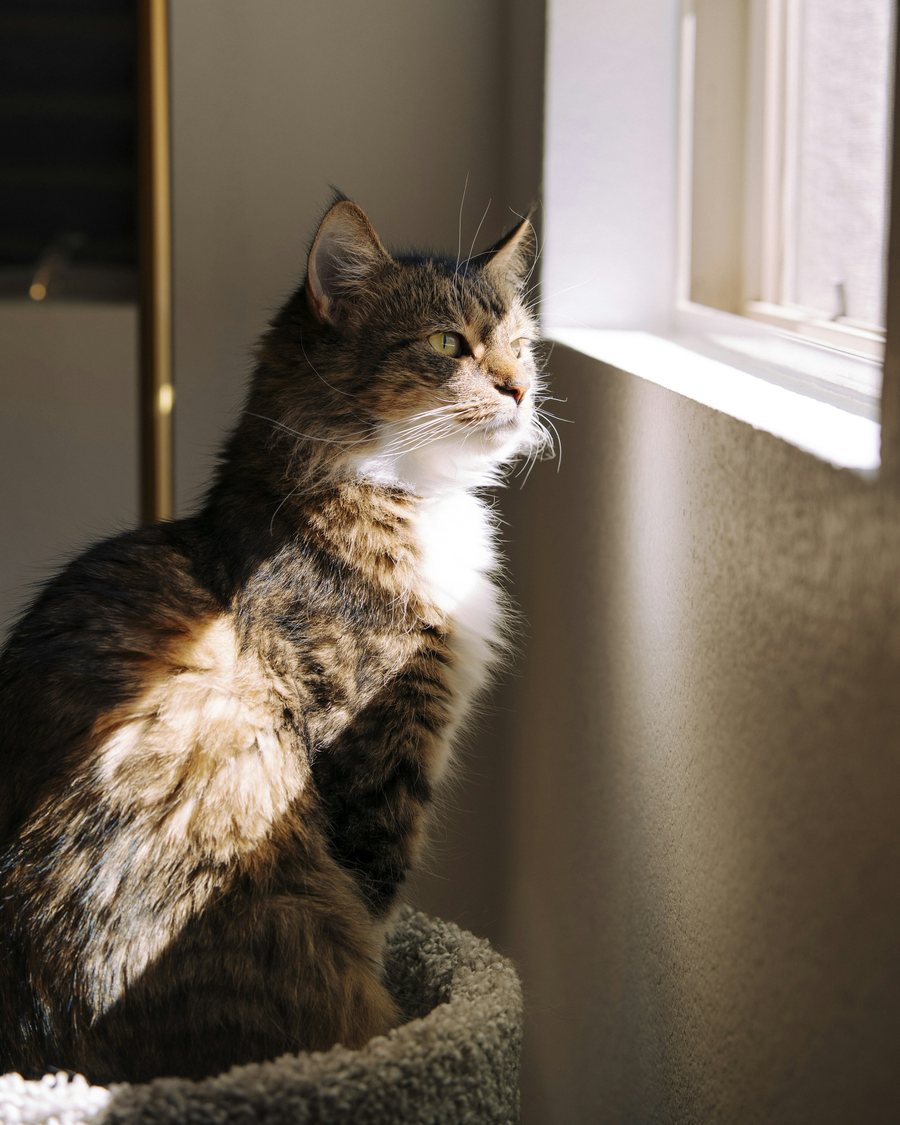 Photo: Unsplash
On farms and behind monastery walls
For centuries she was a quiet coworker. On farms she kept the mice from the grain, in towns from the storehouses, on ships from the provisions. She seldom appears by name in the chronicles. But she was everywhere.
And sometimes she did get a name. In the early ninth century an Irish monk, probably in the circle of Reichenau Abbey on Lake Constance, wrote a little poem into his notebook, between Latin hymns and grammar exercises. It is about his cat Pangur Bán, white Pangur. The monk hunts for the meaning of difficult words, the cat hunts mice, and each is content in his work. The manuscript is kept today in the abbey library of St. Paul im Lavanttal in Austria. More than a thousand years later, you can still feel in those lines the quiet friendship between a person and a cat, at a desk by candlelight.
A breed with the same face
There is also a pedigree cat meant to preserve this look: the European Shorthair. Its roots go back to the early twentieth century, when breeders in northern Europe wanted to keep the original Nordic house cats. The Fédération Internationale Féline (FIFe) recognizes it as a breed in its own right and describes a medium to large, muscular and supple cat with a large head, round eyes and a short, dense, glossy coat. The stated aim of breeding is to stay as close as possible to the type of those original cats. The World Cat Federation knows the same cat as the Celtic Shorthair.
The pedigree cat is a lovely reflection. But this portrait belongs above all to the other one, the cat without papers who lives in so many homes and may be curled up beside you right now.
Each one an original
Because no one ever bred her toward an ideal, every house cat is an original. There is the tabby and the black, the ginger and the gray, the one with a white bib and the one with four white socks. There is the adventurer who knows every corner of the garden and the quiet one who would rather sleep in the laundry basket. Her character tells you much about what she has lived through, especially in her first weeks. How deeply that early time shapes a cat is the subject of The twelve weeks that shape a kitten.
For her health there is no breed standard and no breed-specific DNA test. What is good for her is what is good for any cat: regular visits to the vet, the right preventive care and a home where she can hunt, climb and rest. Your vet will know what suits your cat.
She may already be waiting
Walk through any animal shelter and you will meet her again and again. Tabby, black and white, gray, ginger, with white paws or without. Many of the cats waiting there for a home look just like her. Each has her own story, her own preferences and her very own way of showing you, one day, that she likes you. If you are thinking about giving a cat a home, the shelter is well worth a visit. We share more on our Rescue page.
What remains
We can trace her origins to a wildcat in the Fertile Crescent, her pattern to a single gene and her closeness to us to a grave on Cyprus. What no one can explain is why she stayed. Why a wildcat who never needed us to survive decided one day to sit by our fire, and has never left it since. Perhaps she doesn’t know herself. Perhaps the answer lies in the moment she climbs into your lap in the evening, turns twice and settles down with a deep sigh. As if, after ten thousand years, she had finally arrived.
Read next: Why cats rub their heads on you
Sources
- Driscoll, C. A., Menotti-Raymond, M., Roca, A. L. et al. (2007). The Near Eastern origin of cat domestication. Science, 317(5837), 519–523.
- Vigne, J.-D., Guilaine, J., Debue, K., Haye, L. & Gérard, P. (2004). Early taming of the cat in Cyprus. Science, 304(5668), 259.
- Science News Explores (2004). The taming of the cat. snexplores.org. (Shillourokambos: cat about eight months old; animals brought to Cyprus from the mainland.)
- Ottoni, C., Van Neer, W., De Cupere, B. et al. (2017). The palaeogenetics of cat dispersal in the ancient world. Nature Ecology & Evolution, 1, 0139.
- Royal Belgian Institute of Natural Sciences (2017). Domestication of the cat: ancient DNA reveals significant role of the Near East and Egypt. naturalsciences.be. (Press release on Ottoni et al., 2017.)
- Kaelin, C. B., Xu, X., Hong, L. Z. et al. (2012). Specifying and sustaining pigmentation patterns in domestic and wild cats. Science, 337(6101), 1536–1541.
- Yong, E. (2012, September 20). One way to skin a cat: same genes behind blotches of tabbies and king cheetahs. National Geographic, Phenomena. nationalgeographic.com.
- CODECS — St. Paul im Lavanttal, Stiftsbibliothek, MS 86a/1 (Reichenau Primer, early ninth century, containing the Old Irish poem Pangur Bán). codecs.vanhamel.nl.
- Fédération Internationale Féline (FIFe) — Breed profile European (EUR). fifeweb.org.
- World Cat Congress — Breed comparison: European Shorthair / Celtic Shorthair (recognition by FIFe, WCF, TICA). worldcatcongress.org.
General information, not veterinary advice. Photos: Unsplash.