Why cats rub their heads on you
She walks up, lowers her head and presses her cheek into your hand, your chin, the corner of your laptop. It looks like affection. Research suggests it is something even older: a greeting written in scent.
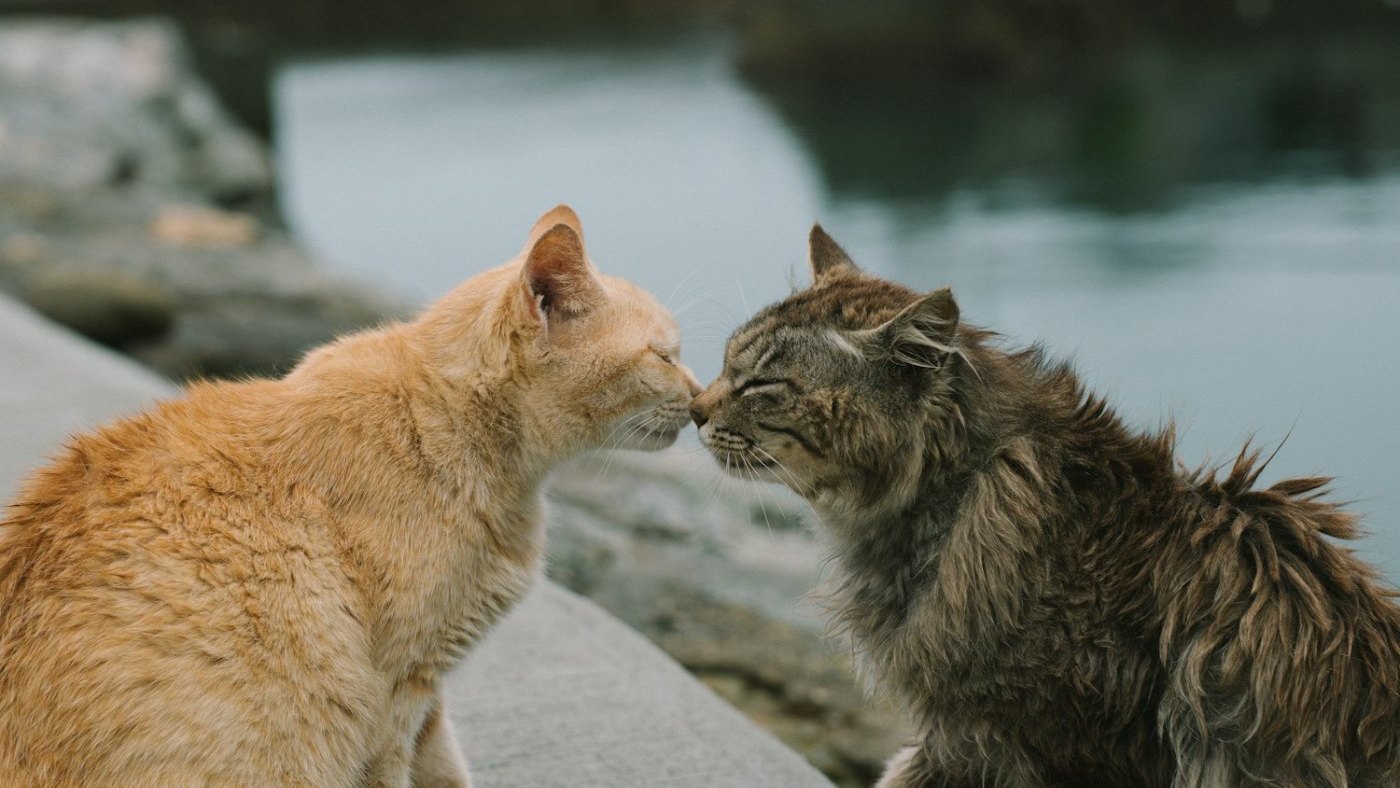 Photo: Unsplash
Some greetings need no words. She crosses the room, pauses, and then the top of her head meets your shin, your hand, your cheek if you lean close enough. A slow sweep along the side of her face follows, often ending at the base of her ear, sometimes with her whole flank. Then she looks at you as though something has been settled.
People call it head bunting. Researchers have a plainer word for the version cats share with each other: allorubbing.
What the research suggests
It is how cats who belong together say hello. In studies of cats living in groups, friendly cats rub heads, cheeks and flanks against one another, and often wind their tails together as they pass. Rubbing appears between cats who also groom each other and rest side by side, not between rivals (Crowell-Davis et al., 2004).
It carries a message only she can fully read. A cat has scent glands on her chin, on her cheeks and in front of her ears. When she rubs against you, she leaves a trace of that scent and takes a little of yours. Over time, a shared smell may help a group of cats recognise one another as family (Bradshaw, 2013).
It often flows in one direction. In colonies, rubbing was frequently offered by younger or smaller cats towards older or larger ones, much as a kitten greets her mother (Bradshaw, 2013). When she rubs against you, she may be greeting you as someone at the heart of her world.
Answering her
Offer a relaxed hand at the height of her face and let her decide how much to lean in. Many cats seem to enjoy being stroked most around the cheeks and just in front of the ears, the very places they rub with, and less at the base of the tail (Ellis et al., 2015). If she presses into your fingers, follow her lead. If she moves on after a moment, that was the whole conversation, and a complete one.
What stays a mystery
We can describe the glands, the direction, the company she keeps when she does it. What it means to her when she chooses your hand, out of everything in the room, is hers to know.
Research suggests; it does not prove. Much of what we know about rubbing comes from cats living in groups, and every cat brings her own dialect.
Read next: What the slow blink actually says
Sources
- Crowell-Davis, S. L., Curtis, T. M. & Knowles, R. J. (2004). Social organization in the cat: a modern understanding. Journal of Feline Medicine and Surgery, 6(1), 19–28.
- Bradshaw, J. (2013). Cat Sense: How the New Feline Science Can Make You a Better Friend to Your Pet. Basic Books.
- Ellis, S. L. H., Thompson, H., Guijarro, C. & Zulch, H. E. (2015). The influence of body region, handler familiarity and order of region handled on the domestic cat’s response to being stroked. Applied Animal Behaviour Science, 173, 60–67.
General information, not veterinary advice. Photos: Unsplash.