The beckoning cat · Japan
A lord on his way home, a white cat at a temple gate, one raised paw — and then the rain. How a small gesture in old Edo became one of the best-loved figures in the world.
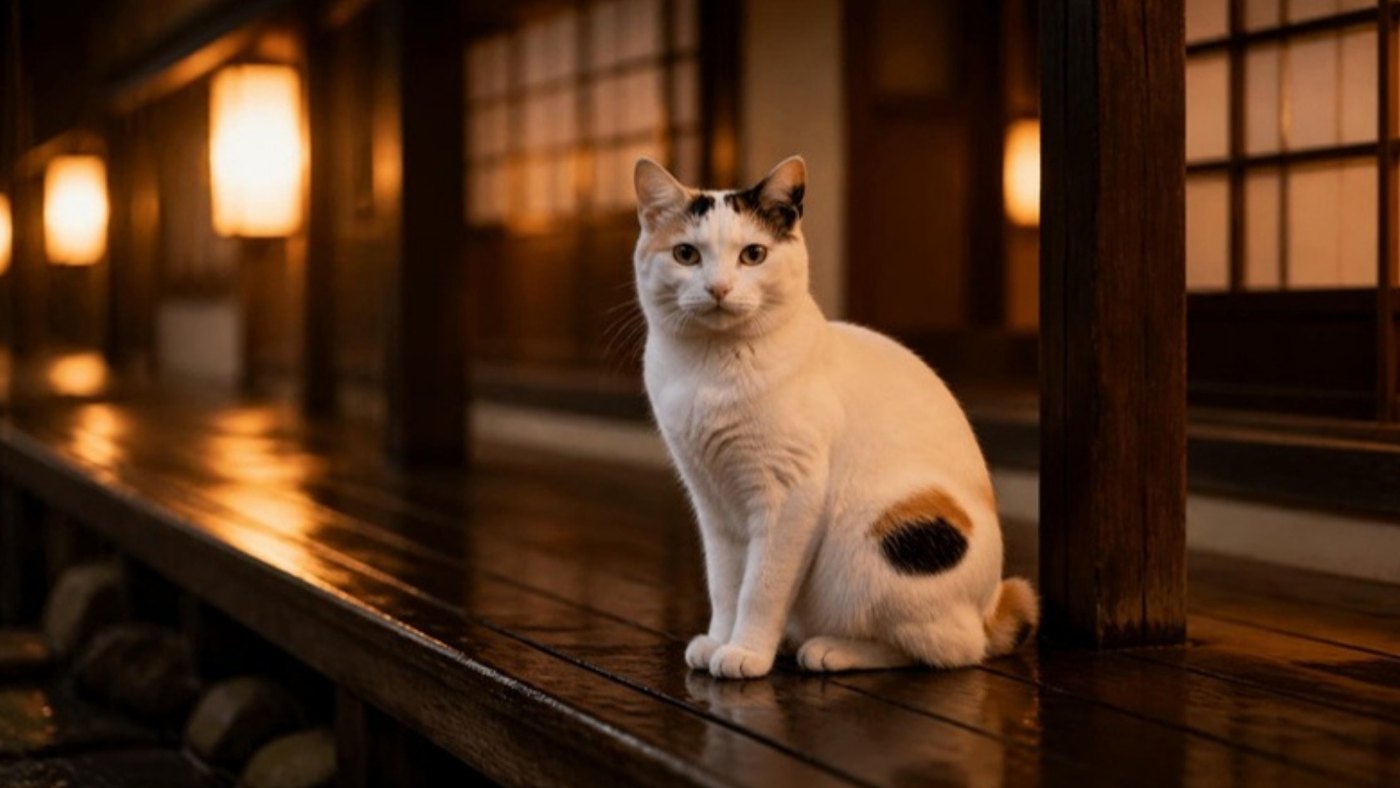 AI-generated
It begins, as so many good stories do, with someone on the way home. Early in the seventeenth century, in the countryside west of Edo — the city that would one day be called Tokyo — a lord and his companions are riding back from a day of falconry. The road leads past a small temple, and at its gate sits a cat. As the riders draw near, she lifts one paw and calls them in. There is no mistaking it.
The lord was Ii Naotaka, ruler of the Hikone domain. He was a real man, and his family’s bond with this temple can still be read in its stones today. The cat belongs to legend. And no one tells that legend more tenderly than the temple itself.
The legend of Gōtoku-ji
So it is told: Naotaka accepted the invitation, dismounted and stepped inside. The head of the temple welcomed him, and the two fell into a long and pleasant conversation. While they talked, thunder suddenly broke overhead and the rain came down, one of those downpours that turn a road into a stream within minutes. The lord sat warm and dry and understood that a small cat had spared him all of it. In some retellings a bolt of lightning strikes close by, and the cat has saved far more than his clothes. In others she has a name, Tama, and belongs to the temple’s priest.
Naotaka did not forget. With his support the temple was rebuilt in 1633, and in 1659 it was renamed in his honour, after his posthumous Buddhist name: Gōtoku-ji. It became the family temple of the Ii, and the graves of the lords of Hikone still rest there beneath the trees, a national historic site since 2008. The cat was honoured too. The temple writes her name with characters that mean, more or less, “the cat who beckons good fortune”, and since 1933 a hall has stood there whose name means the Hall of Beckoning Fortune.
Today more than a thousand small white figures stand beside that hall, row upon row, shoulder to shoulder, each lifting its right paw. Many people bring them back, the temple says, once a wish has come true. Unlike most lucky cats, they hold no gold coin. The temple’s own explanation is one of the loveliest things ever said about the beckoning cat: she brings you the chance to meet people. What you make of that chance is up to you.
Other cradles, other stories
Gōtoku-ji is not the only place that treasures a first beckoning cat. In Asakusa, around Imado Shrine, people tell of an old woman who had grown so poor that she could no longer feed her beloved cat, and with a heavy heart she let her go. That night the cat came to her in a dream and asked her to make figures in her likeness. The woman shaped them from the local Imado ware and sold the little cats near the shrine — and her fortune turned. Elsewhere in Tokyo, at the temple Jishō-in, another tradition remembers the warrior Ōta Dōkan, who had lost his way until a black cat beckoned him to safety.
Which story came first, no one can say, and perhaps that is just as it should be. What history does record is quieter and no less charming. In 1852 the woodblock artist Utagawa Hiroshige pictured the marushime-neko, small cats of Imado ware, being sold at Sensō-ji temple in Asakusa. It is the oldest known image of the beckoning cat, and the Edo-Tokyo Museum keeps the series to this day.
The language of the paw
First, a small secret: she is not waving goodbye. In Japan you call someone towards you with your palm facing outwards, folding your fingers downwards — exactly the movement of that raised paw. To many Western eyes it looks like farewell. In truth it means the opposite: come in.
Which paw she raises carries meaning too, although the meanings shift from place to place and from maker to maker. A raised right paw, it is usually said, beckons good fortune and riches. A raised left paw beckons people — guests, visitors, friends. Some figures raise both, which not everyone loves, because two raised hands can also mean giving up. And the higher the paw, so they say, the more distant the luck it can reach.
Her colours speak as well. White is the classic, for good fortune of every kind. The three-coloured calico, the mike-neko, has long been especially beloved, because such cats were thought rare and therefore lucky. Black is said to keep misfortune away, red once protected against illness, gold beckons wealth and pink beckons love. New colours keep arriving, blue and green among them, each carrying a wish of its own.
What a real paw remembers
The cat at the top of this page wears a few patches in three colours, and she lifts her paw as if she were deciding at this very moment whether to invite you in. Watch any cat washing her face and you will see the gesture: the paw raised, gently curved, drawn down over the ear. There is an old Japanese saying about that, too. When a cat washes all the way behind her ears, so it is said, rain is on its way. A cat, a raised paw, and rain. It is hard not to think of a lord at a temple gate.
Perhaps your cat has never beckoned anyone in from a storm. But think of the people she has brought into your life, the conversations that began with her, the evenings she made warm. At Gōtoku-ji they would recognise that kind of luck at once. It is the luck that beckons, and then waits to see what you will do.
Perhaps tonight, as your cat washes behind her ears, she will lift her paw for a moment. Whom she is beckoning, she does not say.
Read next: Freyja's cats · Scandinavia
Sources
- Gōtoku-ji Temple, Tokyo — “History” and “About Manekineko of Gotokuji temple” (gotokuji.jp/en).
- nippon.com — “Fortune Beckons: Japan’s Lucky Cat Figurines” (nippon.com/en/nipponblog/m00038).
- Saunders, R. (2021, 3 May). The fascinating history behind the popular “waving lucky cat”. National Geographic.
- Japan Creative Centre, Embassy of Japan in Singapore (2023). The Luckiest Cat in the World. JCC E-Magazine, January 2023.
- JAL SKYWARD+ (2022, 27 June). 招き猫とは?由来や種類、ポーズ&色別でご利益を解説 [What is the maneki-neko? Origins, types, poses and colours] (in Japanese).
- Edo-Tokyo Museum Digital Archives — Utagawa Hiroshige I, Jōruri-machi hanka no zu (浄瑠璃町繁花の図), woodblock prints, 1852.
- ITmedia NEWS / tenki.jp (2015, 22 January). 「猫が顔を洗うと雨になる」はホント? [Does it really rain when a cat washes its face?] (in Japanese).
The cat photo on this page is AI-generated.