Why cats love boxes
Set an empty box on the floor, and she is in it before you have folded the flaps. Researchers have studied refuge, warmth, and even squares that exist only as an illusion. The spell itself remains unbroken.
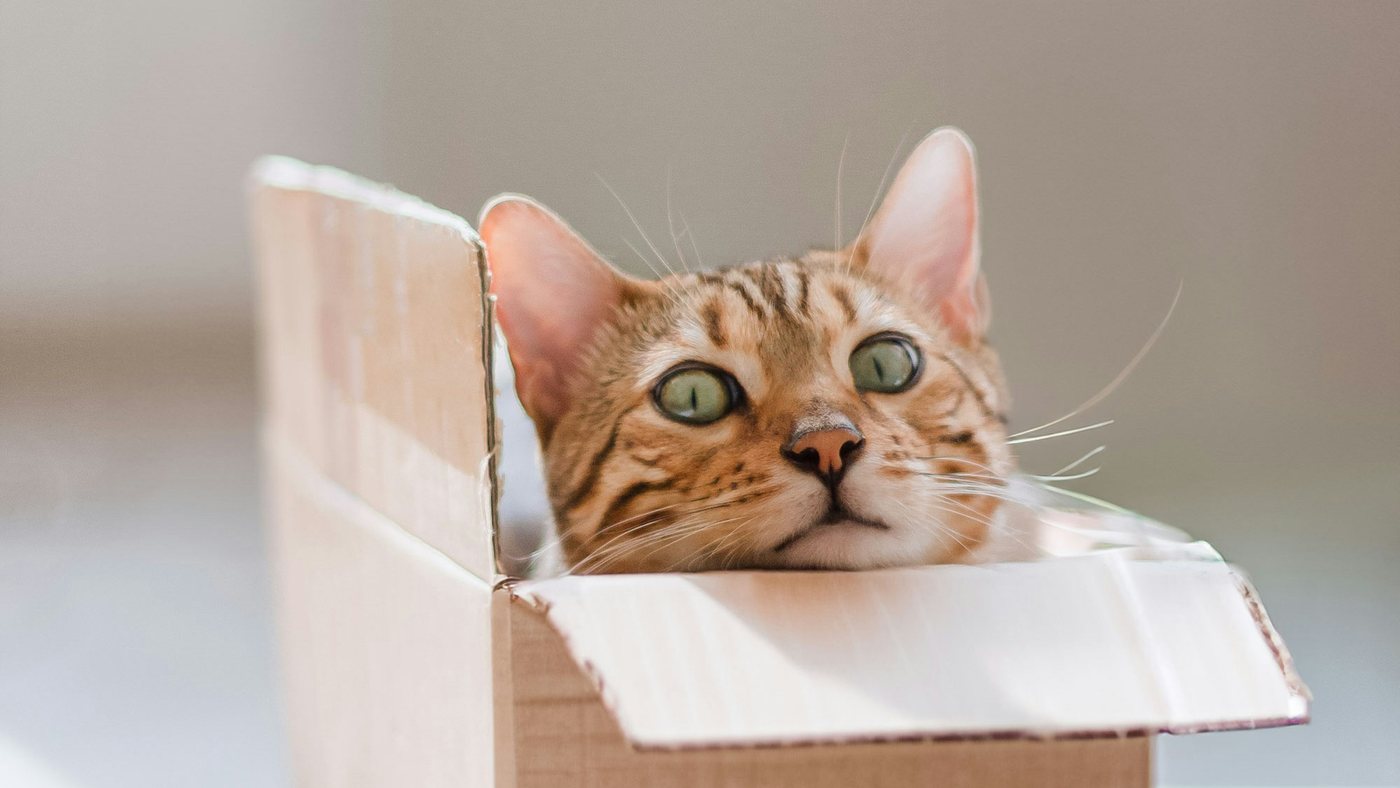 Photo: Unsplash
The package is open, the gift is on the table, and the empty box is still sitting on the floor. You turn away for a moment. When you look back, she is inside: paws tucked neatly beneath her, eyes half closed, as if this box had been waiting for her all along. The gift means nothing to her. The box is the gift.
Almost everyone who shares a home with a cat knows this moment. A shoebox, a fruit crate, a laundry basket, a lid barely deeper than her paws. What she finds within four thin walls is something science has only recently begun to look at closely. Sometimes she barely fits. Then she spills over the edges, a paw here, her tail there, and sits with all the dignity of a queen on her throne.
What the research found
A hiding place is more than furniture. A sheltered spot from which she can watch without being watched: how much that matters to her shows most clearly where everything is unfamiliar. In a study of cats in a rescue shelter, researchers found that the cats fared markedly better when they were able to hide effectively. One worry also proved unfounded. Being able to retreat did not make the cats any less likely to find a new home (Kry & Casey, 2007).
A box can soften an arrival. At a shelter in the Netherlands, ten newly arrived cats were given a simple hiding box, and nine others were not. Over two weeks, the researchers repeatedly scored each cat’s posture and behavior for signs of tension. By the third day, the cats with boxes were clearly more at ease. By day fourteen, both groups had settled to the same calm level, but the cats with boxes had reached it around day three, while the others only caught up toward the end of the second week (Vinke et al., 2014).
A second look agreed. A few years later, a team that included the same researchers repeated the study with 23 cats, this time assigning them to the two groups at random. The cats with a hiding box reached their settled level by day two, the others not until day nine (van der Leij et al., 2019). Body weight and time to adoption did not differ between the groups. The box was no miracle cure. What it gave them was time.
Perhaps warmth plays a part. Cats are comfortable at temperatures most of us would find too warm. The range in which a cat’s body needs to do no extra work to warm or cool itself, her thermoneutral zone, is commonly given as roughly 86 to 100 °F, or 30 to 38 °C (Stella & Croney, 2016). Few homes are kept that warm. A snug box, with her curled up inside, might hold her own heat close, the way cupped hands shelter a flame. No one has measured this yet. It remains a guess, if a warm one.
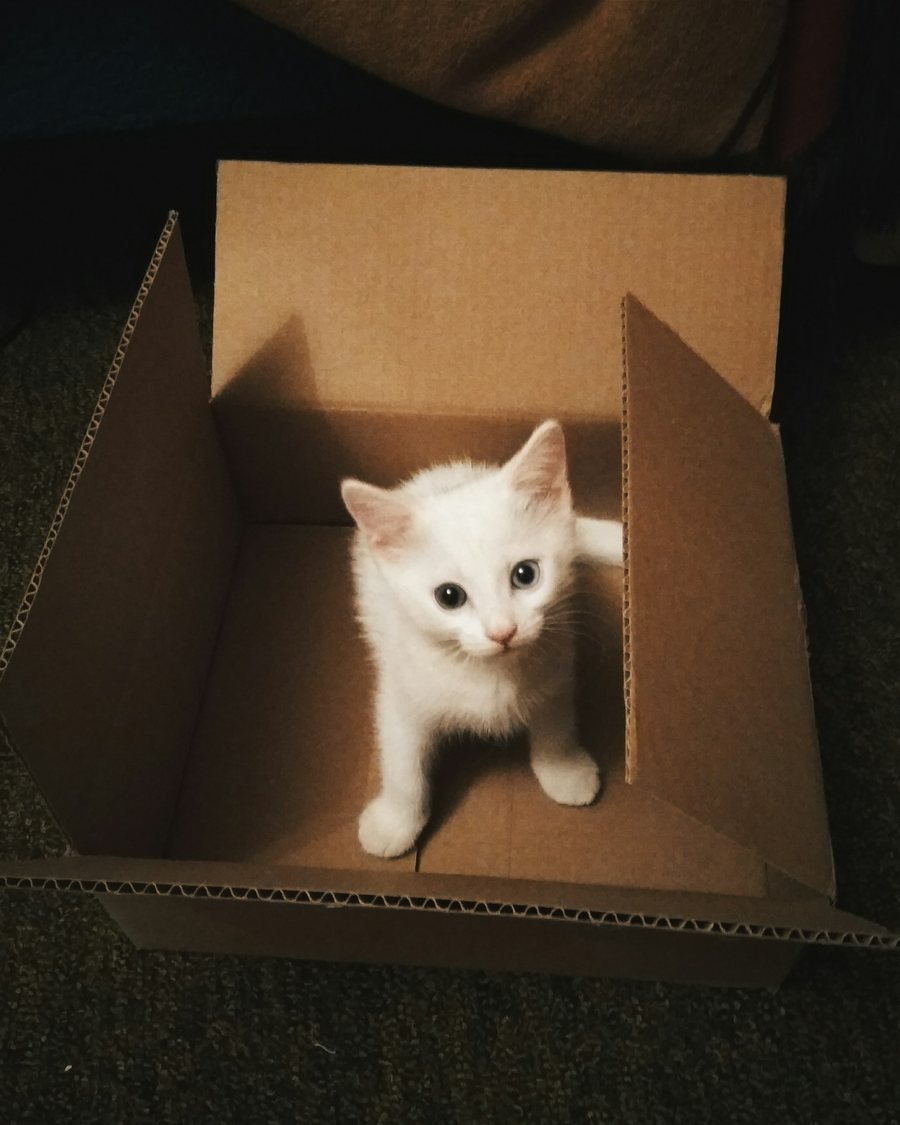 Photo: Unsplash
Even a drawn square will do. In the summer of 2020, with much of the world staying home, researchers invited cat owners into an unusual experiment. The owners printed out shapes and laid them on the floor in pairs over six days: an outlined square, a control figure, and an optical illusion known as the Kanizsa square. It is made of nothing but four circles, each with a quarter cut away, and our eyes fill in the missing edges to see a square that is not there. Thirty cats completed all six days, and nine of them sat in one of the figures at least once. They chose the illusory square almost as often as the outlined one, and the control figure just once (Smith et al., 2021). Cats may see, as we do, edges where there are only hints. The group was small, the trials took place in living rooms, and the team itself calls for a repeat under controlled conditions. Still, the lead is enchanting.
Watching for yourself
Use painter’s tape to mark a square on the floor, just large enough for her to fit, somewhere she often passes. Then do nothing. Simply watch whether, and when, she finds it. If you like, try four corners with no lines joining them. Notice how long she stays, and whether she comes back the next day. Perhaps it becomes her spot; perhaps she ignores it entirely. Either way, it is an answer. And when a box comes into your home, set it on its side with the opening facing the room, a little away from the bustle. Let her keep it, even if she stays for hours. After a move, or when guests arrive, a place like this can be a quiet gift.
What remains
A box shields her from view, may hold her warmth, and helps a cat in a strange place find her calm sooner. That much the research supports. But a square of tape shields nothing, warms nothing, hides nothing. And still she steps inside, turns once, and settles, as though she had crossed a threshold only she can see. We see a piece of cardboard. She sees something else: a den, a lookout, a place that belongs to her alone. Perhaps a border is all she needs to turn a patch of floor into such a place. Why, no one knows. That part belongs to her.
Research suggests; it does not prove. The two shelter studies followed 19 and 23 cats through their first days, and in the square experiment only 9 of 30 cats chose a figure at all. Whether a box holds warmth has not been measured. Where the evidence is thin, we have said so.
Read next: Why cats knead
Sources
- Kry, K. & Casey, R. (2007). The effect of hiding enrichment on stress levels and behaviour of domestic cats (Felis sylvestris catus) in a shelter setting and the implications for adoption potential. Animal Welfare, 16(3), 375–383.
- Vinke, C. M., Godijn, L. M. & van der Leij, W. J. R. (2014). Will a hiding box provide stress reduction for shelter cats? Applied Animal Behaviour Science, 160, 86–93.
- van der Leij, W. J. R., Selman, L. D. A. M., Vernooij, J. C. M. & Vinke, C. M. (2019). The effect of a hiding box on stress levels and body weight in Dutch shelter cats; a randomized controlled trial. PLoS ONE, 14(10), e0223492.
- Stella, J. L. & Croney, C. C. (2016). Environmental aspects of domestic cat care and management: Implications for cat welfare. The Scientific World Journal, 2016, 6296315.
- Smith, G. E., Chouinard, P. A. & Byosiere, S.-E. (2021). If I fits I sits: A citizen science investigation into illusory contour susceptibility in domestic cats (Felis silvestris catus). Applied Animal Behaviour Science, 240, 105338.
General information, not veterinary advice. Photos: Unsplash.