Why cats knead
The slow press of her paws, left and right, the claws opening and closing like a flower: she learned it in the first days of her life. That she still offers it to you, years later, tells a quiet and lovely story.
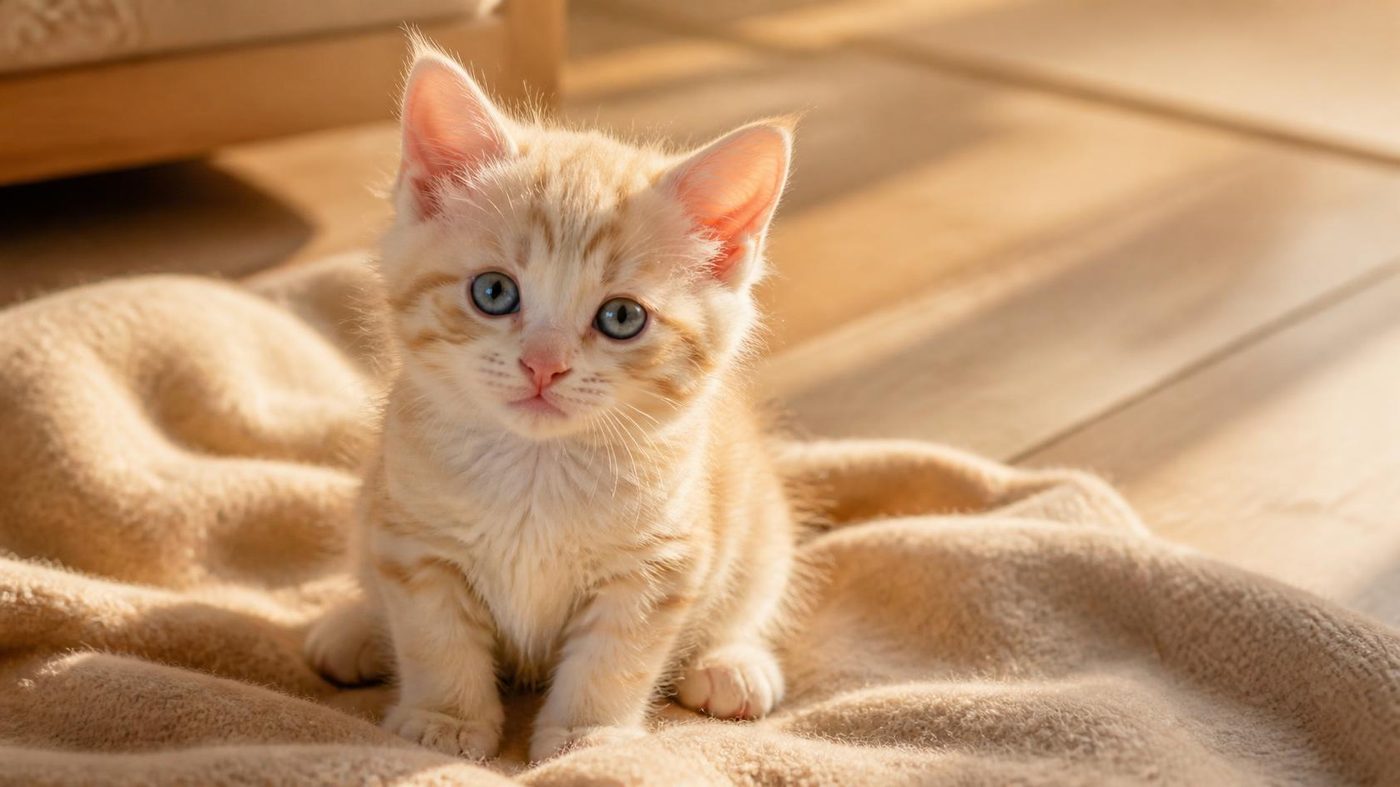 AI-generated
She arrives in the evening, climbs into your lap, and before she settles she begins: one paw, then the other, pressing into the blanket over your knees in a slow, even rhythm. Her eyes half close. Sometimes the claws open and close with each press, sometimes a purr starts up underneath, and now and then — when she is very deep in it — a small damp spot appears at the corner of her mouth. Then, as if a clock somewhere had struck, she turns once and lies down.
In German this has its own tender word, Milchtritt — the milk tread — and the name already holds the whole story.
What the research tells us
It begins at her mother’s belly. In her first days a kitten’s eyes are still closed, and she finds her way to the nipple by smell — kittens even seem to recognise their own particular nipple by its scent (Arteaga et al., 2013). Once there, she presses with her forepaws as she suckles. Veterinarians and behaviour scientists describe this treading as a way of encouraging the milk to flow (AAHA, 2024; Bartels, Scientific American). And in that very place, along the soft groove between the two rows of teats, glands begin a few days after birth to release a scent that seems to calm kittens and adult cats alike (Pageat & Gaultier, 2003). It is one of the very first things a cat ever does with her paws.
She carries it with her into adulthood. Most kitten behaviours fade as a cat grows. Kneading often does not. Behaviour scientists suggest it is one of the gestures domestic cats keep from kittenhood — biologists call this neoteny — and that it surfaces when she feels what she felt then: warm, held, safe (Bartels, Scientific American). It appears on soft blankets, on laps, on the people she has chosen.
Her paws leave a signature. A cat’s paw pads and the skin between her toes hold glands that release scent (Pageat & Gaultier, 2003). Each press may leave a trace of her on whatever she kneads — invisible to us, legible to her. Some specialists think kneading may partly be a way of making a place, or a person, smell of home. It is a lovely thought, and for now it remains a hypothesis.
Above all, it belongs to contentment. Veterinary and behaviour specialists describe kneading, in most cases, as the sign of a cat who feels comfortable and safe — often with a purr, sometimes with that blissful little drool (Bartels, Scientific American; AAHA, 2024). Like the purr, it seems less a word than a state of being.
When she kneads on you
There is nothing you need to do. If her claws are part of it, a folded blanket across your lap lets you both stay. Let your hand rest on her back instead of stroking, and feel how the rhythm slows as she settles — how the presses grow lighter, further apart, until they stop. It is a ritual of arrival. And you are the place she has arrived.
What stays a mystery
We know where kneading comes from and what it usually accompanies. What she feels while she does it, we do not know — whether some trace of that first warmth returns to her, or whether the rhythm itself is the comfort. Some memories cats keep to themselves. That part belongs to her.
Kneading is so familiar that it has rarely been studied directly. What we know comes from observing kittens, from what is known about scent glands, and from the experience of veterinarians and behaviour scientists — not from controlled experiments. Every interpretation here is a well-founded guess.
Read next: Why cats purr
Sources
- Arteaga, L., Bautista, A., González, D. & Hudson, R. (2013). Smell, suck, survive: chemical signals and suckling in the rabbit, cat, and dog. In M. L. East & M. Dehnhard (Eds.), Chemical Signals in Vertebrates 12 (pp. 51–59). Springer.
- American Animal Hospital Association (2024). Why do cats knead? Pet owner resource (aaha.org).
- Bartels, M. Why do cats knead like they’re making biscuits? Scientific American (online), with Leticia Fanucchi, Kristyn Vitale and Susan Nelson.
- Pageat, P. & Gaultier, E. (2003). Current research in canine and feline pheromones. Veterinary Clinics of North America: Small Animal Practice, 33, 187–211.
General information, not veterinary advice. The cat photos on this page are AI-generated.