What whiskers know
Those long, pale hairs on either side of her face are not decoration. Each one is rooted in a nest of nerves, and together they read the world in a language of touch we can barely imagine.
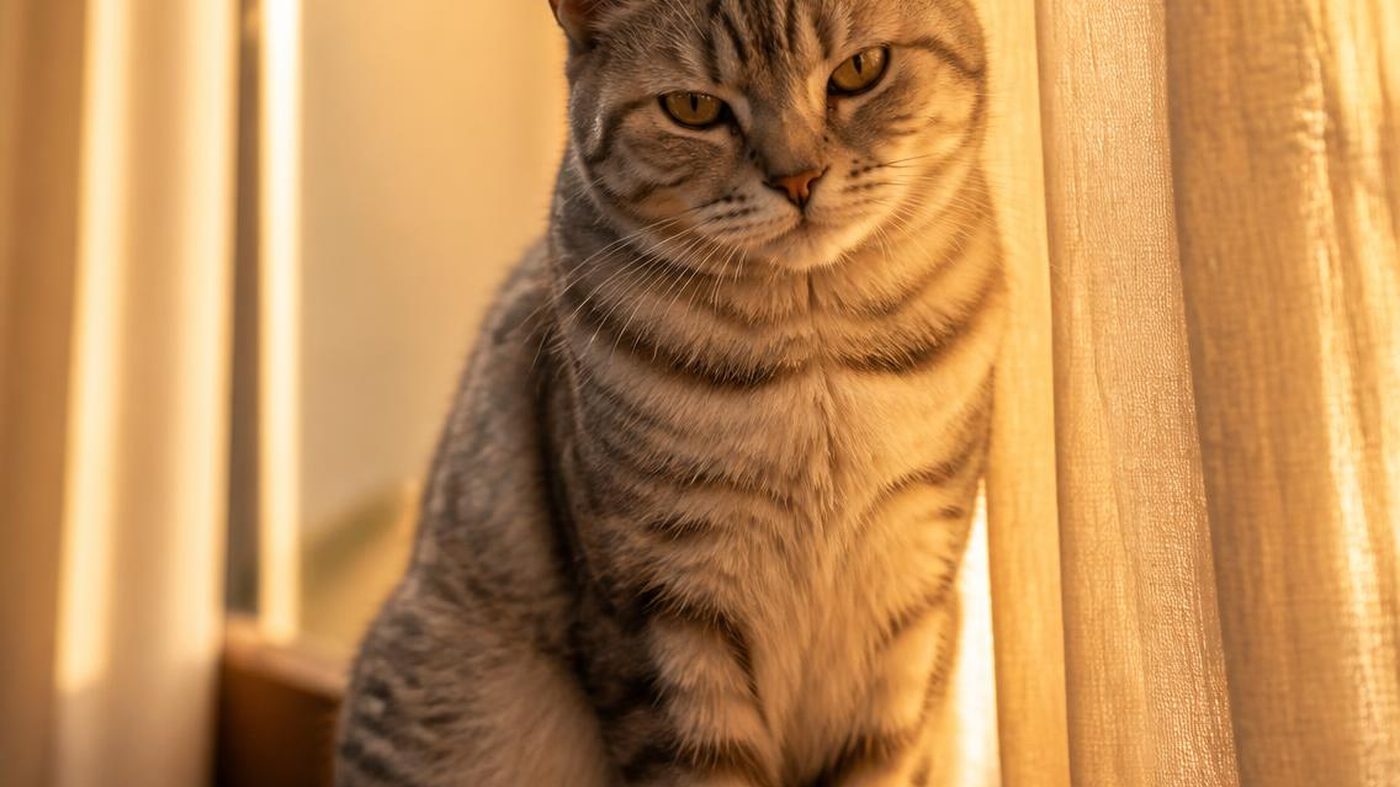 AI-generated
Watch her at a door that stands half open. She pauses, head forward, and for a moment nothing seems to happen. Then the whiskers fan out, their very tips brushing the frame on either side, and she makes her decision — through, or not yet. It is over in a heartbeat. You have just watched her take the measure of the world with her face.
Whiskers — vibrissae, to anatomists — are among the most finely made sense organs any mammal carries. They look like hair. They work more like fingertips.
What the research found
Each whisker grows from a nest of nerves. A whisker rises from a deep follicle wrapped in a small cushion of blood, and that follicle is supplied by an extraordinary density of nerve fibres — in cats, as in rodents and rabbits, roughly one to two hundred for every single whisker (Rice et al., 1986). The hair itself feels nothing. But the faintest bend at its tip travels down the shaft like a lever and is read at the root.
She wears whiskers on her forelegs, too. Look at the back of her foreleg, just above the paw, and you will find a small tuft of stiff hairs: the carpal vibrissae. Many mammals have them (Beddard, 1902). In the cat they grow from a tiny sensory organ rich in mechanoreceptors (Nilsson, 1976). When she pins a toy beneath her paw, she may well be feeling its every twitch.
They may read the air. In rats, researchers have measured how whiskers bend in even a gentle airflow — enough to sense which way a breeze is blowing (Yu, Graff & Hartmann, 2016). Whether cats use theirs in the same way has not been tested so directly. Researchers suspect they do: that the breath of air from an open window, or the air a hand pushes ahead of itself, is for her something felt.
Cats do not sweep — they aim. Rats swing their whiskers back and forth many times a second. Cats, like dogs, do not appear to whisk in this rhythmic way (Prescott, Mitchinson & Grant, 2011). Instead she moves them with intent: pointed forward, fanned wide, laid close along her cheeks.
Their position is part of her expression. At a cat café in Los Angeles, a researcher filmed the encounters of 53 cats over about a year and coded their faces movement by movement. In friendly meetings, the cats tended to bring ears and whiskers forward, towards the other cat (Scott & Florkiewicz, 2023). The whisker result sat right at the edge of statistical significance — a lead, not a rule. Yet anyone who lives with a cat knows that forward, almost curious set of the whiskers when she is interested in you.
Can whiskers grow tired? “Whisker fatigue” — the idea that narrow, deep bowls overstimulate the whiskers at every meal — is widely repeated. When it was tested with 38 indoor cats, a whisker-friendly dish made no measurable difference to how long they ate, how much they ate, or how much they dropped. Yet owners reported that 24 of the 38 cats seemed to prefer the wide, shallow dish (Slovak & Foster, 2021). The fatigue itself is unproven. The preference may be real.
Watching for yourself
Next time she lies close and relaxed, look at her whiskers before you reach for her. Notice where they rest. Then hold out a fingertip some distance from her face and watch: often the whiskers drift forward to meet it before she has moved at all. And if you are curious, set a wide, shallow plate beside her usual bowl for a week. Let her choose.
What stays a mystery
It is often said that a cat’s whiskers span exactly the width of her body. Nobody has measured that carefully. Rats can tell openings apart by their whiskers even when the widths differ only slightly (Krupa et al., 2001), so for cats it is plausible — and still a lovely assumption. What it is like to feel a room through the tips of fine hairs, to sense a hand before it arrives, we cannot know. That part belongs to her.
Research suggests; it does not prove. Much of what we know about how whiskers are built comes from careful laboratory work, and some of it from rats. The café study coded 53 cats, the bowl study followed 38. Where cats have not been measured directly, we have said so.
Read next: Why cats purr
Sources
- Rice, F. L., Mance, A. & Munger, B. L. (1986). A comparative light microscopic analysis of the sensory innervation of the mystacial pad. I. Innervation of vibrissal follicle-sinus complexes. Journal of Comparative Neurology, 252(2), 154–174.
- Beddard, F. E. (1902). Observations upon the carpal vibrissae in mammals. Proceedings of the Zoological Society of London, 72(1), 127–136.
- Nilsson, B. Y. (1976). The mechanoreceptors of the sinus hair organ on the cat’s foreleg. Progress in Brain Research, 43, 215–229.
- Yu, Y. S. W., Graff, M. M. & Hartmann, M. J. Z. (2016). Mechanical responses of rat vibrissae to airflow. Journal of Experimental Biology, 219, 937–948.
- Prescott, T. J., Mitchinson, B. & Grant, R. A. (2011). Vibrissal behavior and function. Scholarpedia, 6(10), 6642.
- Scott, L. & Florkiewicz, B. N. (2023). Feline faces: Unraveling the social function of domestic cat facial signals. Behavioural Processes, 213, 104959.
- Slovak, J. E. & Foster, T. E. (2021). Evaluation of whisker stress in cats. Journal of Feline Medicine and Surgery, 23(4), 389–392.
- Krupa, D. J., Matell, M. S., Brisben, A. J., Oliveira, L. M. & Nicolelis, M. A. L. (2001). Behavioral properties of the trigeminal somatosensory system in rats performing whisker-dependent tactile discriminations. Journal of Neuroscience, 21(15), 5752–5763.
General information, not veterinary advice. The cat photos on this page are AI-generated.