What a raised tail says
She comes to meet you with her tail held straight up, like a small flag. Researchers read it as a friendly greeting, one that may have appeared only when cats began to share their lives with us. It has never been fully deciphered.
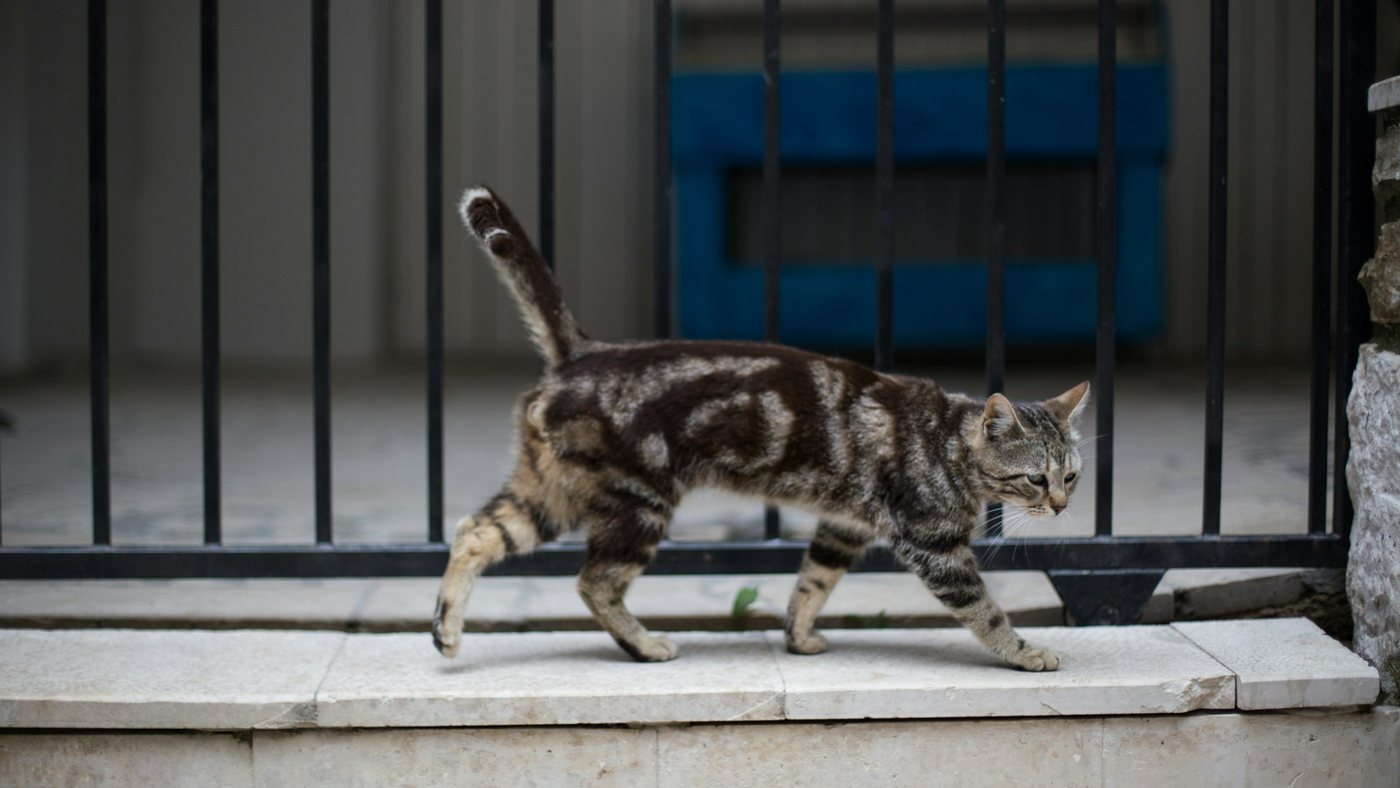 Photo: Unsplash
You turn the key, and before you have even set down your bag, you hear it: the soft patter of paws. She comes down the hallway toward you, unhurried, her tail held straight up in the air, the tip tilted slightly to one side like a question mark. She pauses in front of you, then winds herself along your legs. Not a sound was needed. You understood.
The raised tail is one of the first signs people learn to read in a cat. It is so familiar that we hardly marvel at it anymore. Some cats carry it ahead of them through the whole house, like a small lantern. What is remarkable is how young it may be in the long history of cats, and how much it still leaves researchers wondering.
What the research found
It announces a friendly meeting. In the 1990s, the behavioral scientist Charlotte Cameron-Beaumont watched cats living together in groups. When one cat approached another to rub against her or sniff her, it carried its tail upright in more than 80 percent of those encounters. Nearly every bout of rubbing began with one cat approaching, tail raised. If the other cat raised her tail in reply, rubbing became more likely still (Bradshaw & Cameron-Beaumont, 2000). The tip, researchers note, sometimes bends gently to one side (Vitale, 2022).
A silhouette is enough. Is the tail truly a message, or simply a sign of good spirits? To find out, Cameron-Beaumont showed pet cats cat-sized silhouettes that differed in one detail only: the position of the tail. The cats approached the tail-up silhouette faster and with less hesitation, and more often raised their own tails as they went (Cameron-Beaumont, 1997; Bradshaw & Cameron-Beaumont, 2000). The vertical tail, the researchers concluded, signals an intention to meet in friendship.
It is not a simple hello. Two Italian researchers looked even more closely at a colony of free-ranging cats. Only in a little under a quarter of cases was the raised tail followed by another friendly gesture, and some cats directed it strikingly often toward particular companions. Lower-ranking cats showed it more often; higher-ranking cats received it more often. The tail up, they wrote, “is not simply a greeting behavior” (Cafazzo & Natoli, 2009; Vitale, 2022). Perhaps it is closer to a courtesy, a way for one cat to say that she comes in peace.
Her wild relatives do not use it. Cameron-Beaumont also watched four species of small wild cats in human care, among them jungle cats and caracals. Nearly every social gesture of the house cat appeared in them too, the rubbing as well as the sniffing. Only the raised tail as a friendly signal was missing in all of them (Cameron-Beaumont, 1997). They rubbed against one another without lifting their tails. She suggested that the signal arose in the domestic cat itself, perhaps during the time when cats began to share their lives with people. One remarkable exception is the lion, in which a raised tail has been described during head rubbing (Bradshaw & Cameron-Beaumont, 2000). Whether the gesture is truly so young, or older than we imagine, remains open.
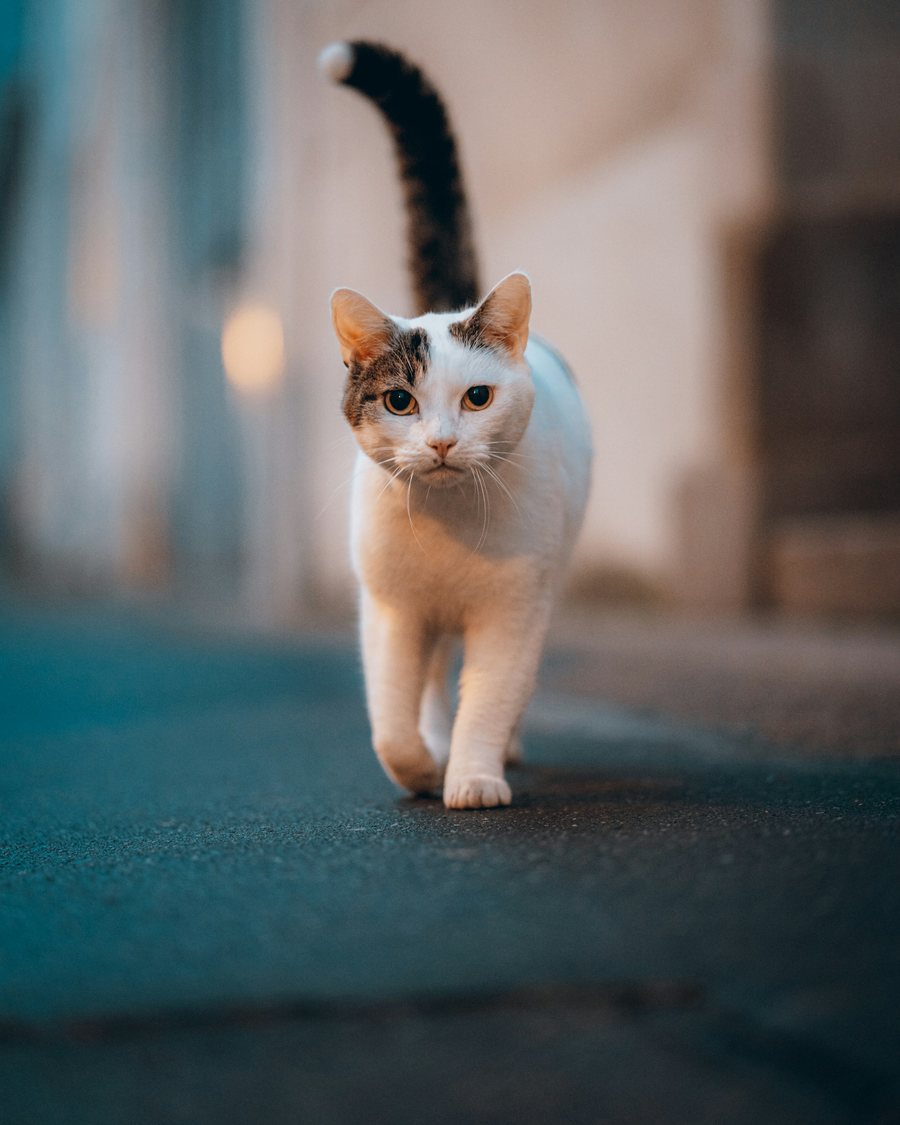 Photo: Unsplash
She shows it to us most of all. In the large outdoor enclosure of a French shelter, a research team watched 29 cats for about a hundred hours. When the cats approached a person, they almost always, in 97.8 percent of cases, held their tails up and their ears erect, and most then rubbed along the person’s legs. Among themselves, by contrast, the cats kept their tails down in three out of four encounters, and their ears turned out to say more about how those meetings would end (Deputte et al., 2021). A signal that plays a quiet part among cats seems to speak to us especially clearly.
Watching for yourself
Over the next few days, notice when her tail rises. When you come home? When you walk into the kitchen in the morning? When she meets another cat? Look at the tip, too, and whether it leans to one side. And when she comes toward you with her tail held high, crouch down, offer your hand quietly, and let her decide whether to rub her cheek against it. It is her greeting. How close she comes is hers to choose. After a week, you may notice that it rises at particular moments, for particular people, in particular rooms. Then you are holding a small map of her affection.
What remains
A tail pointing straight up announces closeness. Among cats it does so quietly, and not always; with us, almost every time. Where the gesture comes from, whether it arose during the long years at our side or is older than research has yet been able to see, no one knows for certain. Perhaps that is what makes it so precious: a sign that may have appeared only when cats began to share their lives with us, and that we will still never read completely. The next time she comes to meet you like this, simply accept it. That part belongs to her.
Research suggests; it does not prove. Much of what we know about the raised tail comes from watching groups of cats and from a single doctoral thesis written in the 1990s. The shelter study observed 29 cats in one enclosure. About cats who live alone with their people, we know less.
Read next: Why cats rub their heads on you
Sources
- Bradshaw, J. & Cameron-Beaumont, C. (2000). The signalling repertoire of the domestic cat and its undomesticated relatives. In D. C. Turner & P. Bateson (Eds.), The Domestic Cat: The Biology of Its Behaviour (2nd ed., pp. 67–93). Cambridge University Press.
- Cameron-Beaumont, C. L. (1997). Visual and tactile communication in the domestic cat (Felis silvestris catus) and undomesticated small felids. Doctoral thesis, University of Southampton.
- Cafazzo, S. & Natoli, E. (2009). The social function of tail up in the domestic cat (Felis silvestris catus). Behavioural Processes, 80(1), 60–66.
- Vitale, K. R. (2022). The social lives of free-ranging cats. Animals, 12(1), 126.
- Deputte, B. L., Jumelet, E., Gilbert, C. & Titeux, E. (2021). Heads and tails: An analysis of visual signals in cats, Felis catus. Animals, 11(9), 2752.
General information, not veterinary advice. Photos: Unsplash.